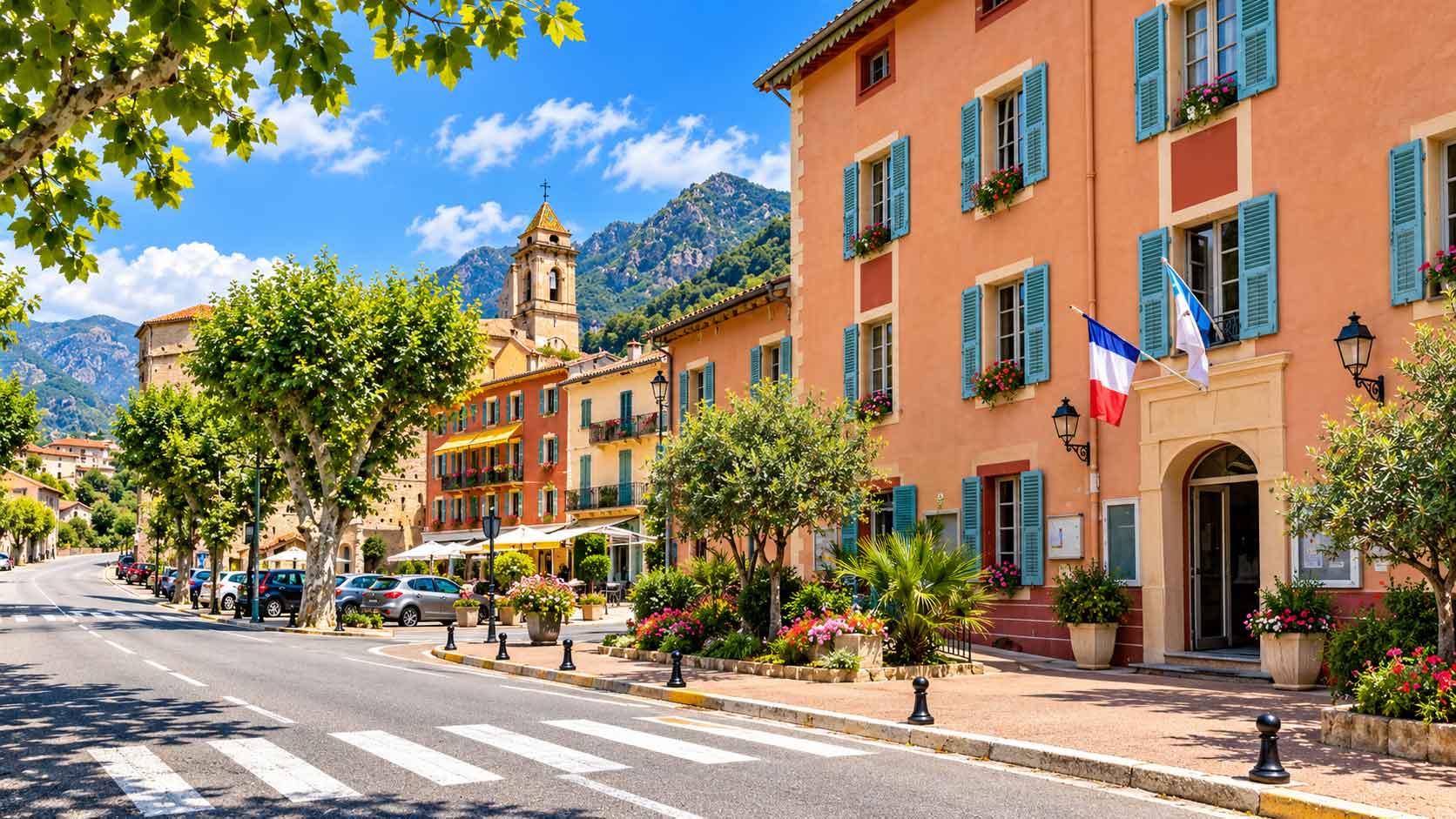
Breil-sur-Roya Travel Guide: Heritage, Mountains and the Roya River
Surrounded by steep mountains and centuries-old olive terraces, Breil-sur-Roya is a historic village in the Roya Valley, close to the Italian border. Its colourful houses are grouped around the river and a peaceful artificial lake, creating one of the most distinctive village landscapes in the Alpes-Maritimes.
Breil-sur-Roya combines medieval lanes, Baroque religious architecture, railway heritage and mountain scenery. It is also a popular starting point for hiking, cycling, canyoning, kayaking and other outdoor activities in the Roya Valley.
The village can easily be visited as a day trip from Nice, Menton or Monaco. The spectacular Train des Merveilles makes the journey part of the experience.
In this Breil-sur-Roya travel guide:
- ◇ Best things to do in Breil-sur-Roya
- ◇ Explore the historic village
- ◇ Walk around the lake and Roya River
- ◇ Visit Sancta-Maria-in-Albis Church
- ◇ Discover the historic chapels
- ◇ See the Porte de Gênes
- ◇ Climb to Cruella Tower
- ◇ Visit the Transport Ecomuseum
- ◇ Discover the A Cùpérà mill
- ◇ History of Breil-sur-Roya
- ◇ Hiking and outdoor activities
- ◇ What to eat in Breil-sur-Roya
- ◇ Best time to visit
- ◇ How to get to Breil-sur-Roya
- ◇ Parking and getting around
- ◇ One-day itinerary
- ◇ Places to visit nearby
- ◇ Frequently asked questions
Best Things to Do in Breil-sur-Roya
Begin your visit along the water before entering the narrow streets of the historic centre. The village is compact enough to explore on foot, but its heritage and surrounding trails can easily fill an entire day.
The principal attractions include the lake, Sancta-Maria-in-Albis Church, the Chapel of Mercy, Saint-Antoine-l’Ermite Chapel, the medieval Porte de Gênes, Cruella Tower, the Transport Ecomuseum and the traditional A Cùpérà olive and flour mill.
Breil-sur-Roya is also known for its local producers, olive-growing traditions and access to white-water sports. The surrounding mountains offer hiking routes ranging from short panoramic walks to demanding full-day circuits.
Explore the Historic Village
Breil-sur-Roya developed in a narrow section of the Roya Valley where the mountains leave only limited space beside the river. Its houses are grouped closely together, and many of the side streets are narrow, shaded and connected by steps or covered passages.
Walk along Rue de Turin and explore the surrounding lanes with their colourful façades, arched doorways, stone details and architectural influences from both the French and Italian sides of the Alps.
The historic centre preserves the atmosphere of an old Ligurian mountain town. Small squares, fountains, religious buildings and former defensive structures reveal the village’s importance on the route between the Mediterranean coast and Piedmont.
Some streets are steep and contain steps. Comfortable shoes are recommended, particularly if you plan to continue towards the Crottés, Porte de Gênes or Cruella Tower.
Walk Around the Lake and Roya River
The lake in the centre of Breil-sur-Roya was created after the Second World War. Surrounded by colourful houses and mountain slopes, it has become one of the village’s most recognisable features.
A walk along the water provides attractive views of the old village, the bell towers and the surrounding olive terraces. Benches and open areas make the lakeside a pleasant place for a break or picnic.
The Roya River is a powerful mountain waterway. Its appearance can change quickly after heavy rain, and visitors should respect barriers, warning signs and restrictions near the water.
The riverside is particularly photogenic in the morning and late afternoon, when the façades and mountains are reflected in the calmer sections of the water.
Visit Sancta-Maria-in-Albis Church
Sancta-Maria-in-Albis Church is the principal religious monument of Breil-sur-Roya. Classified as a Historic Monument, the present building was completed around 1700 on the site of an earlier medieval church that had been badly damaged during the seventeenth century.
The church reflects the Baroque culture that spread through the Roya and Bévéra valleys. Its interior contains richly decorated altars, religious paintings, sculptures and an important organ case.
The elegant bell tower, topped by a colourful tiled roof, is one of the most visible landmarks in the centre of Breil-sur-Roya.
Opening hours can depend on religious services, guided visits and heritage events. Check with the tourist office if visiting the interior is an important part of your trip.
Discover the Historic Chapels
Chapel of Mercy
Located close to Sancta-Maria-in-Albis Church, the Chapel of Mercy belonged to a brotherhood of penitents. These religious associations played an important social role by organising processions, charitable work and assistance for the local population.
The chapel forms part of the protected historic heritage of Breil-sur-Roya and illustrates the importance of Baroque religious culture in the valley.
Saint-Antoine-l’Ermite Chapel
Located near the old southern entrance to the village, Saint-Antoine-l’Ermite Chapel was restored in the seventeenth century. Its traditional stone-slab roof and religious artwork make it one of the most characteristic small monuments in Breil.
The chapel stands only a few metres from the Porte de Gênes. Travellers once stopped here to pray before entering or leaving the fortified village.
Sainte-Catherine Chapel
The Chapel of Sainte-Catherine d’Alexandrie is another protected religious monument in Breil-sur-Roya. Its history is connected with the brotherhoods and spiritual traditions that shaped village life.
The interiors of the chapels are not necessarily open every day. Their façades and surrounding streets can nevertheless be viewed throughout the year.
See the Porte de Gênes
The medieval Porte de Gênes is the last surviving gateway from the walls that once enclosed Breil-sur-Roya. It was one of three entrances providing access to the fortified settlement.
The gate stood on the route towards Libre and the territories connected with Genoa. Until the early nineteenth century, it closed the historic path entering the village from the south.
The gate and remaining section of wall are freely visible throughout the year. They can easily be included in a walk to Saint-Antoine-l’Ermite Chapel and the paths above the village.
Climb to Cruella Tower
The Cruella Tower stands high above Breil-sur-Roya and is one of the symbols of the village. The surviving tower formed part of an old defensive and lookout system protecting the settlement and the Roya Valley.
The walking route climbs steeply above the village, but rewards visitors with wide views over the lake, historic centre, olive terraces and surrounding mountains.
The path requires suitable footwear and can be exposed to the sun. Carry water, avoid the hottest hours in summer and keep away from unprotected edges.
Check current trail conditions before departure, as mountain paths can be affected by erosion, maintenance work or severe weather.
Visit the Transport Ecomuseum
The Transport Ecomuseum, also known as the Ecomuseum of the Train des Merveilles, is located near Breil-sur-Roya railway station. It presents the history of railways and transport in the Roya and Vermenagna valleys.
The collection includes historic railway equipment, documents, models, technical objects and rare vehicles associated with the international railway line connecting Nice, Ventimiglia, Breil-sur-Roya, Tende and Cuneo.
The museum is particularly interesting for families, railway enthusiasts and travellers arriving on the Train des Merveilles. Opening days and times vary according to the season, so check the current schedule before visiting.
Discover the A Cùpérà Mill
The restored A Cùpérà mill was traditionally used to produce olive oil and flour. It is now a museum dedicated to the agricultural knowledge and working methods of earlier generations.
The mill explains how olives and cereals were processed using local water resources and mechanical equipment. It also illustrates the importance of olive cultivation on the terraces surrounding Breil-sur-Roya.
Visits may require advance booking through the tourist office and may be organised only for a minimum number of participants. Check the current arrangements before your visit.
Visit the House of Local Producers
The House of Local Producers is a useful place to discover products from the Roya Valley. Depending on the season, visitors may find olive oil, olives, honey, cheese, preserves, biscuits, herbal products and local crafts.
Opening days can vary. It is advisable to check the current schedule, especially outside the main visitor season.
History of Breil-sur-Roya
Archaeological discoveries show that the area around Breil-sur-Roya has been inhabited since prehistoric times. Its position on a natural route through the Alps later gave the settlement commercial and military importance.
During the Middle Ages, the village developed inside defensive walls near a castle and several gateways. The Roya Valley linked the Mediterranean coast with Piedmont, making Breil an important stopping point for travellers, merchants and armies.
Over the centuries, the village was influenced by Provence, the County of Nice, the House of Savoy, Piedmont, Liguria and France. This complex history remains visible in its architecture, dialect, cuisine and religious traditions.
Railway construction transformed Breil-sur-Roya into an important international transport centre. The railway line required tunnels, bridges and engineering works across difficult mountain terrain and remains one of the most spectacular rail journeys in southeastern France.
In October 2020, Storm Alex caused catastrophic flooding throughout the Roya Valley. Roads, railway infrastructure, homes and public spaces were severely damaged. Major reconstruction work has since restored access and services, while the event remains an important part of the valley’s recent history.
Hiking and Outdoor Activities
Walk to Cruella Tower
The climb to Cruella Tower is one of the most popular short hikes from the village. It offers extensive views without requiring a full day, although the steep ascent still demands appropriate footwear and reasonable fitness.
Circuit de Libre
The Circuit de Libre explores the slopes and traditional hamlets above the Roya Valley. The route takes approximately three hours and includes around 500 metres of ascent and descent.
It is generally classified as a moderately difficult walk and can be completed during much of the year, depending on weather and trail conditions.
Libre hamlet
Located at approximately 600 metres above sea level, the hamlet of Libre is known for its olive groves and traditional rural landscape. For centuries, movement between the hamlet and the valley was mainly on foot or with donkeys and mules.
The balconies and paths around Libre offer views over the Roya Valley and provide insight into the agricultural history of the surrounding mountains.
Circuit de la Déa
The Circuit de la Déa is a demanding mountain hike lasting approximately 5 hours 30 minutes, with about 830 metres of ascent and descent.
It is recommended mainly from June to October and is intended for experienced hikers with appropriate equipment, water, food and navigation skills.
Hiking between Breil and Sospel
A longer route connects Breil-sur-Roya with Sospel across the mountain landscape separating the Roya and Bévéra valleys. This is a demanding point-to-point hike requiring advance transport planning.
Mountain biking
The Lavina circuit offers an accessible mountain-bike route of approximately 10 kilometres. It takes around 1 hour 30 minutes and includes roughly 300 metres of climbing and descending.
More experienced riders can explore longer ridge routes between the Roya and Bévéra valleys. Always remain on authorised trails and respect hikers, wildlife and local restrictions.
Canyoning and white-water sports
Breil-sur-Roya is an important centre for white-water activities. Local providers offer kayaking, rafting, hydrospeed, aquatic hiking and canyoning.
The Maglia Canyon and the Carleva Valley are well-known technical routes. They require proper equipment, experience and knowledge of current water conditions.
Visitors without canyoning experience should use a qualified guide. Never enter a canyon after heavy rain or when storms are forecast.
What to Eat in Breil-sur-Roya
The cuisine of Breil-sur-Roya combines influences from Nice, Liguria, Piedmont and the mountain valleys. Local dishes are based on seasonal vegetables, olive oil, herbs, cheese, meat and traditional handmade pasta.
Look for barbajuans, ravioli, vegetable pies, gnocchi, polenta, stuffed vegetables, daube and dishes prepared with local olives and olive oil.
Depending on the season, local shops and producers may also offer honey, goat or sheep cheese, jams, biscuits, dried fruit and herbal products.
A weekly market is generally held on Tuesday morning around Place Biancheri. Traffic and parking in the centre may be affected during market hours.
Best Time to Visit Breil-sur-Roya
Spring is ideal for walking through the village and exploring lower hiking trails. Temperatures are comfortable, the vegetation is green and the river landscape is particularly beautiful.
Summer is the main season for canyoning, kayaking and other outdoor activities. Begin hikes early to avoid the heat and check the risk of thunderstorms before entering mountain valleys.
Early autumn offers pleasant temperatures, softer light and quieter streets. It is an excellent period for hiking and photography.
Winter is peaceful and can provide clear mountain views, but some museums, restaurants and visitor services may operate on reduced schedules. Snow or frost can affect higher routes.
How to Get to Breil-sur-Roya
From Nice by train
The most scenic way to reach Breil-sur-Roya is aboard the Train des Merveilles from Nice-Ville station. The railway crosses valleys, tunnels, bridges and mountain landscapes before arriving at Breil-sur-Roya.
The journey generally takes around one hour and ten minutes, depending on the service. Breil station is within walking distance of the historic centre and the lake.
Train times can change because of seasonal schedules, engineering work or operational conditions. Check the official ZOU! or SNCF timetable before departure and confirm the last return to Nice.
From Nice by car
One of the fastest routes from Nice follows the A8 motorway into Italy. Exit at Ventimiglia and follow signs for Tende and Colle di Tenda along the SS20 towards Breil-sur-Roya.
Another scenic route travels through Menton, Sospel and the Col de Brouis. Depending on traffic and the chosen route, allow approximately one hour and ten minutes to one hour and thirty minutes.
From Menton
From Menton, drive towards Sospel, then cross the Col de Brouis to reach Breil-sur-Roya. The route is mountainous and includes numerous bends.
Bus line 25 also connects Menton with Breil-sur-Roya and the other villages of the Roya Valley. The journey from Breil to Menton takes approximately 50 minutes, depending on traffic and the service.
From Monaco
From Monaco, follow the A8 towards Menton and then continue through Sospel and the Col de Brouis. Another option is to continue into Italy and use the route from Ventimiglia towards the Roya Valley.
Depending on traffic and the selected itinerary, the journey generally takes around one hour to one hour and twenty minutes.
From Ventimiglia
From Ventimiglia, follow the SS20 towards Tende and Cuneo. Breil-sur-Roya can also be reached by train on the international line connecting Ventimiglia, Breil and Cuneo.
The train journey between Breil and Ventimiglia takes approximately 40 minutes, depending on the service.
By bus and transport on demand
Bus line 25 serves the Roya Valley between Menton, Breil-sur-Roya and Tende. A transport-on-demand service also operates between several communes and hamlets in the valley.
Timetables and booking conditions can change. Consult Zest, ZOU! and the Menton Riviera & Merveilles Tourist Office before travelling.
Parking and Getting Around
Parking is available in several areas around Breil-sur-Roya, including along the Roya, near the upper bridge, close to the primary school and around the railway station.
The railway station is approximately 500 metres from the village centre. Most attractions in the historic centre can be reached on foot.
Some old streets contain steps and are not accessible to vehicles. Visitors with reduced mobility should remain near the lakeside, main roads and more accessible central areas.
On Tuesday mornings, parking and traffic around Place Biancheri may be affected by the weekly market.
One-Day Itinerary in Breil-sur-Roya
Morning: arrive by Train des Merveilles or car and begin with a walk around the lake. Continue through the narrow streets of the historic centre and visit Sancta-Maria-in-Albis Church if it is open.
Late morning: discover the Chapel of Mercy, Saint-Antoine-l’Ermite Chapel and the medieval Porte de Gênes. Stop at the tourist office for current information about monuments and trails.
Lunch: eat in the village or buy local products for a picnic beside the lake. On Tuesday morning, explore the market around Place Biancheri.
Afternoon: choose between the Transport Ecomuseum, a reserved visit to the A Cùpérà mill or the climb to Cruella Tower. Families may prefer the museum and an easy riverside walk.
Late afternoon: return to the lake, visit the House of Local Producers and enjoy the mountain reflections before taking the train or driving back.
Places to Visit Near Breil-sur-Roya
Saorge
Saorge is one of the most spectacular perched villages in the Roya Valley. Its narrow streets, tall houses, Baroque churches and Franciscan monastery appear to cling to the mountainside.
Fontan
Fontan is a small riverside village between Breil-sur-Roya and Saorge. It provides access to mountain landscapes and the Fontan–Saorge railway station.
La Brigue
La Brigue preserves medieval streets, decorated façades and the remarkable sanctuary of Notre-Dame-des-Fontaines, known for its extensive fifteenth-century frescoes.
Tende
Tende is a historic mountain town near the upper end of the Roya Valley. Its old streets, collegiate church and Musée des Merveilles make it one of the principal destinations in the region.
Sospel
Sospel is located between the Bévéra Valley and the Col de Brouis. Its colourful old town, Baroque cathedral and historic bridge make it an excellent companion destination.
Ventimiglia
Ventimiglia is an Italian coastal town with a medieval upper town, beaches, markets and railway connections to Breil-sur-Roya and Cuneo.
Fort du Col de Brouis
The Fort du Col de Brouis is a former military position overlooking the route between Sospel and Breil-sur-Roya. Access to the interior may be restricted, but the surrounding area illustrates the strategic importance of the mountain pass.
Frequently Asked Questions About Breil-sur-Roya
How long do you need to visit Breil-sur-Roya?
Allow at least half a day to explore the lake, historic centre, church and medieval heritage. A full day is recommended if you also want to visit the railway museum, climb to Cruella Tower or enjoy an outdoor activity.
Is Breil-sur-Roya worth visiting?
Yes. Breil-sur-Roya combines a beautiful riverside setting, colourful historic streets, Baroque monuments, railway heritage, local food and access to mountain adventures.
Can you visit Breil-sur-Roya without a car?
Yes. The village is served by the Train des Merveilles and regional bus services. The railway station, lake and historic centre are within walking distance of one another.
Is the Train des Merveilles operating?
Rail services between Nice, Breil-sur-Roya and the upper Roya Valley operate according to the current ZOU! and SNCF timetable. Schedules may change because of seasonal arrangements or engineering work, so verify them before travelling.
Is Breil-sur-Roya suitable for families?
Yes. Families can walk around the lake, explore the village and visit the Transport Ecomuseum. Mountain trails, riverbanks and steep streets require appropriate supervision.
Can you swim in the lake?
Do not assume that swimming is permitted. Water access and activities depend on local rules, safety conditions and river levels. Follow the signs displayed on site and ask the tourist office for current information.
Can beginners go canyoning in Breil-sur-Roya?
Beginners should book an outing with a qualified professional who can select a route suited to their level. Technical canyons such as Maglia and Carleva require specialist equipment and experience.
Is Breil-sur-Roya accessible to visitors with reduced mobility?
The lakeside and some central areas are relatively accessible, but parts of the historic village contain steps, steep lanes and uneven surfaces. Ask the tourist office for advice on the most suitable route.
Where is the best viewpoint in Breil-sur-Roya?
Cruella Tower offers one of the finest panoramas over the village, lake, Roya Valley and olive terraces. Easier views are available from the lakeside and the roads above the historic centre.
Are museums and churches open every day?
No. Opening hours depend on the season, religious services, guided visits and volunteer availability. Check current schedules before travelling specifically for an interior visit.
City Gallery