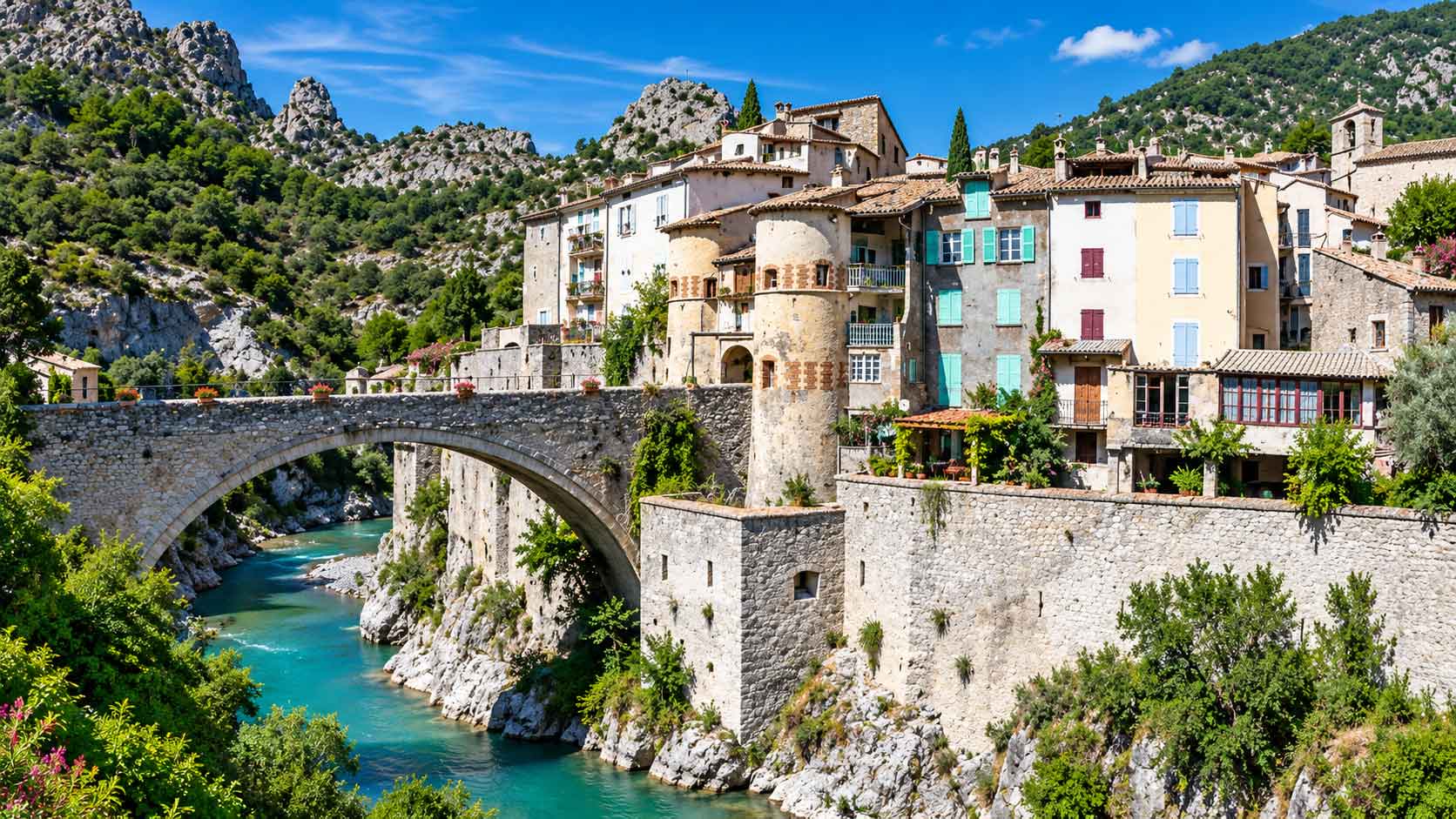
Ascros Travel Guide: A Peaceful Perched Village in the Estéron Valley
Perched at approximately 1,150 metres above sea level, Ascros is a small mountain village surrounded by forests, ridges and the wild landscapes of the Estéron Valley. Its stone houses, narrow streets, Romanesque church and medieval castle ruins create an authentic atmosphere far removed from the busy resorts of the French Riviera.
Ascros lies within the Préalpes d’Azur Regional Natural Park, around 60 kilometres by road from Nice. The village is a rewarding destination for travellers interested in rural heritage, panoramic viewpoints and hiking.
Ascros is very small and can be explored on foot in one or two hours. Its real appeal comes from combining the historic village with a walk, a picnic or a scenic drive through the surrounding mountains.
In this Ascros travel guide:
- Best things to do in Ascros
- Explore the historic village
- Discover the Grimaldi castle ruins
- Visit Saint-Véran Church
- See Sainte-Anne Chapel
- Hike to Sainte-Baume Chapel
- Hike to Mont Brune
- Discover the surrounding hamlets
- Nature and outdoor activities
- Local life, crafts and farm visits
- Where to eat
- Where to stay
- Best time to visit
- How to get to Ascros
- Getting there by public transport
- Parking and getting around
- Suggested one-day itinerary
- Places to visit nearby
- Practical tips
- Frequently asked questions
Best Things to Do in Ascros
The principal attractions in Ascros are its medieval heritage, Romanesque church, panoramic setting and surrounding hiking trails. The village does not contain large museums or commercial tourist attractions. It is best appreciated slowly, by walking through its old streets and exploring the natural landscapes around it.
A half-day is sufficient for the historic centre and a short walk. Allow a full day if you plan to hike to Sainte-Baume Chapel, explore Mont Brune or combine Ascros with nearby villages.
Explore the Historic Village of Ascros
The compact village centre is composed of stone houses, narrow passages, small squares and steep lanes adapted to the mountain terrain. Walking is the best way to explore it.
Begin near the centre and continue towards Place du Château, Saint-Véran Church and the remains of the medieval fortress. Openings between the houses reveal views over the forests, surrounding ridges and valleys of the high country.
Ascros is not a reconstructed tourist village. It remains a small living community, so visitors should respect residents’ privacy, avoid blocking entrances and keep noise to a minimum.
Discover the Grimaldi Castle Ruins
The remains of the feudal castle occupy the historic upper part of Ascros. Construction of the fortified settlement began during the Middle Ages, when the local lord established a castle and church on this strategically positioned site.
The castrum was protected by walls, towers and the natural cliffs surrounding the village. The fortress measured approximately 50 metres in length and included defensive towers, residential rooms, storage spaces and a central system for collecting rainwater.
Ascros later became connected with the powerful Grimaldi family of Beuil, whose possessions extended across many villages in the County of Nice. After the fall of Annibal Grimaldi in the seventeenth century, the castle gradually lost its importance and fell into ruin.
Today, the surviving walls and foundations provide an atmospheric reminder of Ascros’s medieval past. The site also offers views over the village and the surrounding mountain landscape.
The ruins are fragile. Stay on authorised paths, do not climb unstable walls and supervise children near drops or uneven ground.
Visit Saint-Véran Church
Saint-Véran Church stands beside the castle site and is the principal historic monument of Ascros. Although it is traditionally described as a twelfth-century Romanesque church, its present architectural form is generally associated with the first half of the thirteenth century.
The fortified church formed part of the defensive system of the medieval castrum. Its architecture includes a single nave divided into three bays, a pointed barrel vault, a short choir and a semicircular apse.
A porch bell tower was added in 1920, replacing an earlier bell structure. The building has since been carefully restored.
Inside, visitors may see religious paintings and furnishings connected with the history of the village. Opening hours can be limited, so contact the town hall if visiting the interior is particularly important to you.
See Sainte-Anne Chapel
Sainte-Anne Chapel stands near the entrance to Ascros and has traditionally served as a place of pilgrimage. Its location makes it an easy stop before or after exploring the historic centre.
The chapel is also connected with local walking routes. It offers a quieter expression of the village’s religious heritage than the fortified Saint-Véran Church.
The interior may not be permanently accessible. Visitors should respect the building and the surrounding area even when it is closed.
Hike to Sainte-Baume Chapel
Sainte-Baume Chapel is located in a remote natural setting on the slopes south of Mont Brune. Reaching it requires a genuine hike through forests, open slopes and the rural landscapes surrounding Ascros.
Routes may pass through or near the hamlets of Les Chats and Les Crottes before continuing towards the chapel. The landscape provides broad views over the Estéron region and the surrounding mountains.
This should not be treated as a short urban walk. Depending on the chosen circuit, the outing can require several hours and include a significant elevation gain.
Trail conditions can change because of vegetation, erosion, forestry work or bad weather. Consult a recent route description, check the condition of the marked paths and do not rely solely on an old GPS track.
Wear hiking shoes, bring sufficient water and avoid the route during thunderstorms, strong winds or extreme summer heat.
Hike to Mont Brune
Mont Brune rises to approximately 1,500 metres and is one of the most rewarding hiking destinations near Ascros. The route crosses forested slopes and mountain ridges before reaching extensive viewpoints over the Estéron Valley and the surrounding Prealps.
Some itineraries combine Mont Brune with Sainte-Baume Chapel and the hamlets around Ascros. These circuits can be long and require good physical condition, reliable navigation and suitable equipment.
Weather conditions can change rapidly on the exposed ridges. Carry an additional layer, sun protection and enough water, even when conditions appear mild in the village.
Before departure, consult the official Randoxygène information, local trail signs and any notices concerning closed or damaged paths.
Discover the Hamlets Around Ascros
The commune includes several small hamlets and rural localities, including Rourebel, Les Chats and Les Crottes. They are spread along the mountain roads and surrounded by forest, farmland and open countryside.
Les Crottes
Les Crottes lies east of the main village. An ancient Roman route once crossed this area, and walking trails lead towards Sainte-Baume Chapel and Mont Brune.
Les Chats
Les Chats is another small rural settlement encountered on some walking routes from Ascros. It offers a glimpse of the scattered settlement pattern typical of the high country.
Rourebel
Rourebel is located along the road serving the commune. It is primarily a residential and rural hamlet rather than a developed tourist attraction.
Services in these hamlets are very limited. Bring water, food and a downloaded map, and respect private roads, farms and residential properties.
Nature and Outdoor Activities
Ascros lies within the Préalpes d’Azur Regional Natural Park, an area of forests, agricultural valleys, rocky ridges and remarkable biodiversity.
Hiking is the principal outdoor activity, but the area is also suitable for mountain biking, road cycling and nature observation. Experienced riders can include Ascros in longer cycling routes through Puget-Théniers, La Penne, Saint-Antonin and the Estéron Valley.
The mountain roads are narrow and winding, with steep climbs and limited visibility around bends. Cyclists should wear visible clothing and remain alert for vehicles.
Wildlife may include birds of prey, deer and other mountain species. Observe animals from a distance, do not leave the paths unnecessarily and never leave food or rubbish behind.
Local Life, Crafts and Farm Visits
Ascros retains a strong connection with agriculture, local food and traditional crafts. Sheep and goat farming, vegetables, fruit and small-scale rural production form part of the identity of the surrounding region.
La Basse-Cour des Granges
La Basse-Cour des Granges offers farm visits by appointment. It can be an interesting activity for families wishing to discover local agricultural life.
Visits must be arranged in advance. Confirm the meeting point, price and available activities directly with the farm before travelling.
Atelier CéraMika
Atelier CéraMika is a local pottery workshop producing tableware, stoneware signs and sculptures. Visits may be possible by appointment.
Contact the workshop before arriving, as it is not necessarily open as a permanent retail shop.
Where to Eat in Ascros
Ascros has very limited dining options. A communal bar-restaurant operates in the village, and La Table du Rousset is associated with local and Niçoise cuisine.
Opening days can change according to the season, local management and village events. Call ahead and reserve before travelling, particularly in the evening or outside the summer period.
It is sensible to carry water and a snack even if you plan to eat in the village. Additional restaurants and food shops can be found in Puget-Théniers and other larger communities in the Var Valley.
Where to Stay
Accommodation within the commune is limited and consists mainly of rural holiday rentals and guest accommodation. La Bastide du Rousset is one of the properties listed in Ascros.
Visitors wanting more shops and services can stay in Puget-Théniers. Travellers exploring several villages in the Estéron Valley may also consider Roquestéron or nearby rural guesthouses.
Check the precise location before booking. A property in the commune may be outside the historic village and require a car.
Best Time to Visit Ascros
Spring
Spring brings green landscapes, wildflowers and comfortable temperatures for walking. Higher or shaded paths may remain wet after rain.
Summer
Summer is suitable for village visits and hiking, but exposed trails can become very hot during the afternoon. Begin longer walks early and carry more water than you expect to need.
During periods of high wildfire risk, access to forests and mountain areas may be restricted. Check official information before starting a hike.
Autumn
Autumn offers colourful forests, clearer air and quieter trails. Days become shorter, so begin long routes early enough to return before dark.
Winter
Winter is peaceful, but snow, frost and ice are possible at this altitude. Roads and shaded paths can remain slippery even when the coast is experiencing mild weather.
How to Get to Ascros
Driving is the simplest and most reliable way to reach Ascros. The village is served by mountain roads and is not located directly on the main Var Valley road.
From Nice by car
From Nice, follow the M6202 or the appropriate connecting road north-west along the Var Valley towards Digne-les-Bains and Puget-Théniers.
Depending on current road conditions and your navigation route, leave the main valley road towards the mountain villages and follow the D27 in the direction of Ascros. The final section is winding, narrow and includes a considerable climb.
The journey is approximately 60 kilometres and normally takes around 1 hour 15 minutes to 1 hour 35 minutes. Allow additional time for traffic, roadworks and winter conditions.
From Monaco by car
From Monaco, travel towards Nice and join the A8 motorway or local roads in the direction of Nice. Continue towards the Var Valley, then follow the M6202 north-west towards Puget-Théniers.
Leave the main valley route and continue on the mountain roads towards Ascros. Allow approximately 1 hour 45 minutes to 2 hours 15 minutes, depending on traffic around Monaco and Nice.
From Cannes or Antibes by car
From Cannes or Antibes, follow the A8 motorway towards Nice. Leave the motorway to join the Var Valley route towards Digne-les-Bains and Puget-Théniers, then continue towards Ascros using the mountain roads.
Allow approximately 1 hour 45 minutes from Antibes and around 2 hours from Cannes, depending on traffic.
From Puget-Théniers by car
Puget-Théniers is approximately 16 to 18 kilometres from Ascros. Follow the D27 towards the village. The road climbs through a remote mountain landscape and contains many bends.
Allow around 30 to 40 minutes and drive cautiously. Journey times can increase considerably in winter or after heavy rain.
From the Estéron Valley
Ascros can also be approached from Toudon and other villages of the Estéron area using the D27 and connecting departmental roads.
These roads are scenic but narrow. Do not underestimate the driving time based solely on the number of kilometres.
Important driving advice
Enter “Ascros village” or “Place du Château, Ascros” into your navigation application. Download the route before leaving because mobile reception can be inconsistent.
Fill the fuel tank in the Var Valley before climbing to the village. There is no guarantee of finding an open petrol station in Ascros or the neighbouring small communities.
Getting to Ascros by Public Transport
Visiting Ascros without a car is possible only with careful preparation. Public transport is limited and may be organised primarily around school and local travel requirements.
Regional buses
The municipality lists ZOU! regional bus lines 720 and 721 as serving the area. Services are infrequent, and some journeys may operate only on particular weekdays, during school periods or with advance booking.
A journey from Nice may require a connection in the Var Valley or another designated stop. Do not assume that there is a frequent direct bus between central Nice and Ascros.
Before travelling, consult the current ZOU! timetable for both lines and confirm:
- The exact departure point
- Whether the service operates on your travel date
- Whether advance booking is required
- The name of the Ascros stop
- The time and availability of the return journey
Never travel to Ascros by bus without confirming the return service. Taxis are limited and can be expensive when requested from the coast.
Train des Pignes
The Chemins de Fer de Provence, commonly known as the Train des Pignes, runs from Nice through the Var Valley and serves stations such as Touët-sur-Var and Puget-Théniers.
The railway does not climb to Ascros. From the valley station, you will still need a pre-arranged taxi, a confirmed bus connection or another transfer to reach the village.
Puget-Théniers is generally the most practical railway stop because it has more services than the smaller communities, but the best connection depends on the current bus timetable.
Taxi transfer
If using the Train des Pignes, reserve a taxi in advance and agree on the station, meeting time and price. Do not expect to find taxis waiting outside every rural station.
Parking and Getting Around Ascros
Use the designated parking areas near the entrance or centre of the village. Avoid driving into narrow historic lanes unless signs clearly permit access.
The historic centre is small and best explored on foot. The lanes, steps and uneven surfaces may be difficult for visitors with reduced mobility.
Hiking destinations and outlying hamlets may require a car. Park only in authorised areas and never block agricultural tracks, emergency access routes or residents’ entrances.
Suggested One-Day Itinerary in Ascros
Morning
Arrive in Ascros and walk through the historic village. Visit Place du Château, the Grimaldi castle ruins and Saint-Véran Church. Continue towards Sainte-Anne Chapel and stop at the panoramic viewpoints.
Lunch
Have lunch at a village restaurant if it is open, or bring a picnic. Confirm restaurant opening hours before arriving.
Afternoon
Choose a short local walk or part of a marked route towards Les Chats and Les Crottes. Experienced hikers with sufficient time can plan a longer circuit towards Sainte-Baume Chapel or Mont Brune.
Do not begin a long hike late in the afternoon. Mountain paths can be difficult to follow after sunset.
Places to Visit Near Ascros
Puget-Théniers
Puget-Théniers is the principal service centre in the surrounding Var Valley. It has shops, cafés and a station on the Train des Pignes railway.
Touët-sur-Var
Touët-sur-Var is a picturesque village built against the mountainside above the Var Valley. Its narrow streets and railway connection make it an interesting stop.
La Penne
La Penne is a peaceful rural village surrounded by forests and mountain scenery. It can be combined with Ascros on a scenic driving or cycling route.
Saint-Antonin
Saint-Antonin is another small village in the Estéron area offering traditional architecture and access to quiet natural landscapes.
Roquestéron
Roquestéron is one of the principal villages of the Estéron Valley and offers additional services, restaurants and access to outdoor activities.
Entrevaux
Entrevaux is known for its fortified medieval village, dramatic citadel and bridges over the Var. It can be reached from Puget-Théniers by road or the Train des Pignes.
Gorges de Daluis
The Gorges de Daluis are famous for their red rock formations and spectacular road. They can be included in a longer road trip through the high country.
Practical Tips for Visiting Ascros
- Wear comfortable shoes suitable for stone streets and uneven paths.
- Bring water, food and sun protection.
- Check restaurant opening hours before travelling.
- Download offline maps before leaving the Var Valley.
- Fill the car with fuel before climbing to the village.
- Check weather and trail conditions before hiking.
- Start long walks early and carry a charged telephone.
- During summer, check wildfire-access restrictions.
- During winter, carry the required snow equipment.
- Respect private property, farms and fragile castle ruins.
Frequently Asked Questions About Ascros
Is Ascros worth visiting?
Yes. Ascros is worth visiting for its peaceful atmosphere, medieval castle ruins, Romanesque church, mountain views and hiking routes. It is best suited to travellers who appreciate nature and small historic villages.
How much time do you need in Ascros?
Allow one or two hours for the historic village. A half-day is suitable for the village and a short walk, while a full day is necessary for a longer hike.
Can you visit Ascros without a car?
It is possible but difficult. Regional buses are limited, and the Train des Pignes does not reach the village. Check lines 720 and 721 carefully or arrange a taxi transfer from a valley station.
Is there a direct train to Ascros?
No. The Train des Pignes serves the Var Valley, including Puget-Théniers and Touët-sur-Var, but a road transfer is still required to reach Ascros.
Is Ascros suitable for children?
Yes, the village can be visited with children. Supervise them around castle ruins, steep paths and exposed viewpoints. Select hiking routes appropriate for their age and experience.
Can you enter Saint-Véran Church?
The church may have limited opening hours. Contact Ascros Town Hall in advance if visiting the interior is an important part of your trip.
Is the castle open as a museum?
No. The castle survives as an archaeological ruin rather than a conventional museum. Visitors can see the remains but must respect safety barriers and fragile structures.
Are there restaurants in Ascros?
Dining options are very limited and opening days can change. Contact the village restaurant in advance and carry food and water as a precaution.
What is the best season for hiking?
Late spring and early autumn generally offer the most comfortable conditions. Summer hikes should begin early, while winter routes may be affected by snow, ice and short daylight hours.
City Gallery