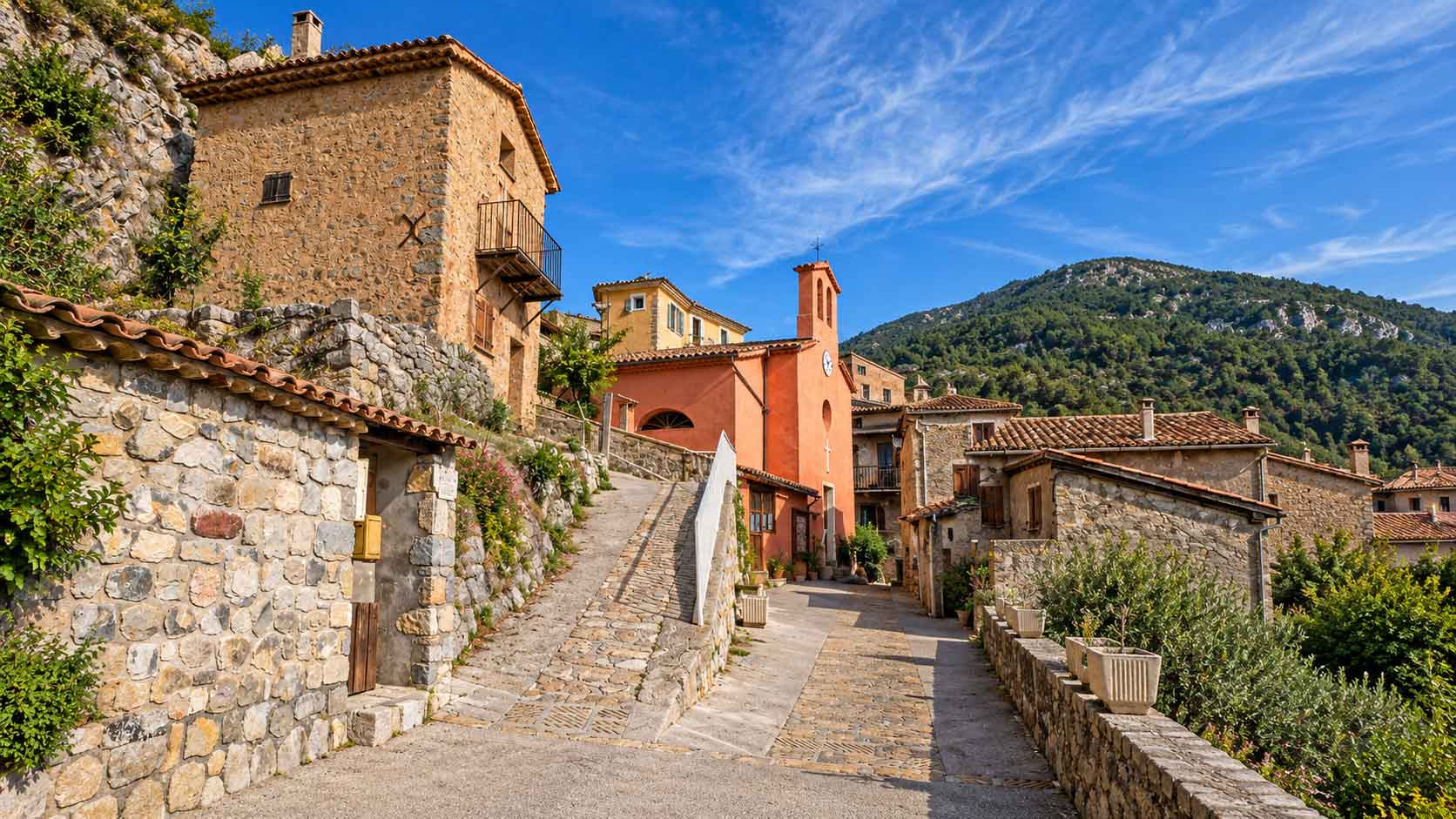
Auvare
Discover Auvare, a tiny mountain village above the Var Valley, with traditional stone houses, the Church of Saint Peter, castle ruins, pastoral landscapes and spectacular hiking routes towards Mont d’Auvare and the Dôme de Barrot.
Auvare Travel Guide: A Remote Mountain Village in the Alpes-Maritimes
Auvare is a tiny mountain village located high above the Var Valley in the Alpes-Maritimes. Surrounded by forests, rocky ridges and traditional pastoral landscapes, it is one of the smallest and most secluded villages in the department.
Built in an impressive eagle’s-nest position, Auvare offers traditional stone houses, a historic church, the remains of an old defensive system and expansive views over the mountains of the Roudoule region. The village is also a starting point for several demanding hiking routes, including trails towards Mont d’Auvare and the Dôme de Barrot.
Auvare is not a conventional tourist destination. There are very few services, no large attractions and little commercial activity. Its appeal comes from its silence, authenticity, mountain scenery and sense of isolation. Visitors should arrive with water, food, suitable clothing and enough fuel for the return journey.
In this Auvare travel guide:
- Best things to do in Auvare
- Explore the mountain village
- Church of Saint Peter
- Castle ruins and old fortifications
- Pastoral heritage and dry-stone structures
- Mountain viewpoints
- Tour of Mont d’Auvare
- Hiking to the Dôme de Barrot
- Cycling to Auvare
- Food and practical services
- Where to stay
- Best time to visit
- How to get to Auvare
- Public transport
- Parking and getting around
- One-day itinerary
- Places to visit nearby
- Frequently asked questions
Best Things to Do in Auvare
Auvare is a destination for travellers who enjoy quiet villages, remote mountain roads, hiking and traditional rural heritage. The village itself is very small and can be explored quickly, but the surrounding landscapes deserve much more time.
1. Explore the Mountain Village
Auvare occupies a dramatic position above the valleys of the Roudoule and the Var. Its houses are grouped closely together on the mountainside, creating the appearance of a small stone nest overlooking the surrounding countryside.
Walk through the narrow lanes and observe the traditional architecture, stone façades, old wooden doors, fountains and agricultural buildings. Unlike the more famous villages of the French Riviera, Auvare has remained largely untouched by mass tourism.
The village is residential, exceptionally quiet and home to only a very small population. Visitors should avoid making unnecessary noise, blocking entrances or entering private land.
2. Visit the Church of Saint Peter
The Church of Saint Peter, known in French as the Église Saint-Pierre, is the principal religious monument in Auvare. It was built on the remains of an earlier chapel dedicated to the Virgin Mary.
The church’s simple appearance reflects the isolated mountain environment and the limited resources of the historic community. It remains an important symbol of village life and local identity.
The interior may not be open outside religious services, village events or heritage celebrations. Even when the building is closed, its exterior and setting can be appreciated during a walk through the village.
3. Discover the Castle Ruins and Old Fortifications
On the rock above Auvare are the remains of a castle that was mentioned in historical records as early as 1252. Its elevated location provided a strategic view over the surrounding valleys and routes through the mountains.
Only ruins remain today, and the site should be approached carefully. Stones can be unstable, paths may be steep and there may be no protective barriers.
The village also preserves an old gateway that once formed part of its defensive system. Together with the castle ruins, it illustrates the importance of security for isolated medieval communities.
4. See the Village Calvary
A traditional calvary forms part of Auvare’s religious landscape. Crosses and small devotional monuments were commonly placed at village entrances, crossroads or elevated locations throughout the mountain communities of the Alpes-Maritimes.
These simple structures are reminders of the religious traditions that shaped everyday life in isolated rural settlements.
5. Discover the Pastoral Heritage
Sheep farming has historically been one of Auvare’s principal economic activities. The surrounding landscape preserves traces of this pastoral life, including sheepfolds, old tracks, terraces and dry-stone enclosures.
Dry-stone walls were built without mortar and were used to define grazing areas, protect cultivated land and manage livestock. They are an important part of the cultural landscape of the southern French Alps.
Do not enter working farms or enclosed grazing areas without permission. Keep dogs under control, particularly when livestock and guardian dogs are present.
6. Enjoy the Mountain Viewpoints
Auvare offers far-reaching views over the Roudoule region, the Var Valley and the surrounding peaks. The approach road itself provides several impressive perspectives, although drivers should stop only in safe designated areas.
Early morning often provides the clearest mountain views. In the evening, the changing light highlights the rocky slopes and the traditional houses of the village.
Weather can change quickly at this altitude. Clouds, fog, wind and thunderstorms may arrive even when conditions appear calm in the lower valley.
7. Hike the Tour of Mont d’Auvare
The Tour du Mont d’Auvare is one of the best-known hiking routes in the area. The circuit normally begins at La Croix-sur-Roudoule, crosses the mountain landscape around Mont d’Auvare and passes through or close to the village of Auvare.
Depending on the exact route, the loop is approximately 8.5 to 9 kilometres long, with around 500 to 560 metres of elevation gain. Allow between four and five hours for the complete hike.
The itinerary includes forest tracks, rocky paths, exposed slopes and steep sections. It offers views towards the Roudoule Valley, the Mairola mountains and the distinctive red landscapes of the Dôme de Barrot region.
This hike requires proper walking shoes, sufficient water, sun protection and a detailed map or downloaded GPX route. Do not rely exclusively on mobile telephone coverage.
8. Hike Towards the Dôme de Barrot
The Dôme de Barrot rises to approximately 2,135 metres and is one of the most remarkable mountains in this part of the Alpes-Maritimes. It is known for its unusual red rocks and its broad views over the Var, Cians and Roudoule valleys.
A long route to the Dôme de Barrot can be undertaken from Auvare. Depending on the selected itinerary, the hike may cover around 17 kilometres with approximately 1,200 metres of elevation gain.
This is a demanding mountain excursion suitable only for experienced and properly equipped hikers. Allow most of the day and start early. Navigation skills may be necessary, particularly when visibility is poor or trail markings are difficult to follow.
Snow can remain on higher sections outside summer, while thunderstorms are common during warm afternoons. Check the weather forecast, trail conditions and official access restrictions before leaving.
9. Cycle the Mountain Road to Auvare
The climb to Auvare is attractive to experienced road cyclists looking for a quiet and challenging mountain route. The road rises from the Puget-Théniers area through a series of bends and provides increasingly open views over the valley.
The road is narrow and may contain gravel, stones or damaged surfaces. Cyclists should use appropriate lighting, wear a helmet and remain alert for local vehicles.
The descent requires particular care because of tight bends, steep sections and changing road conditions.
Food and Practical Services
Auvare has extremely limited commercial services. Visitors should not expect to find a supermarket, permanent tourist office, petrol station or a reliable choice of restaurants in the village.
Bring drinking water, snacks and any essential supplies before driving into the mountains. The nearest practical centre for groceries, bakeries, cafés, restaurants, fuel and other services is Puget-Théniers.
If planning a picnic, take all rubbish away with you. Open fires and barbecues may be prohibited because of the risk of wildfire.
Where to Stay Near Auvare
Accommodation inside Auvare is very limited and may consist only of occasional holiday rentals or private properties. Travellers should arrange accommodation before arriving.
Puget-Théniers offers the most practical base for visiting Auvare, with easier access to shops, restaurants, public transport and the Train des Pignes.
Additional guesthouses and rural accommodation may be found around Puget-Rostang, La Croix-sur-Roudoule, Entrevaux, Guillaumes and Valberg.
For hikers planning a long mountain route, accommodation should be booked in advance, especially during summer weekends and local events.
Best Time to Visit Auvare
The best period to visit Auvare is generally from late spring to early autumn, although conditions depend greatly on altitude and weather.
Spring: the lower slopes become green and wildflowers appear. Snow or muddy ground may still affect higher routes.
Summer: the village is usually accessible, but exposed hiking trails can become hot. Afternoon thunderstorms and wildfire restrictions are possible.
Autumn: cooler temperatures, clear views and changing forest colours make this one of the best seasons for walking.
Winter: snow, ice and difficult road conditions are possible. Some mountain routes may require winter equipment or may be unsuitable for ordinary hikers.
How to Get to Auvare
By Car from Puget-Théniers
Puget-Théniers is the nearest service centre and the usual starting point for reaching Auvare. From Puget-Théniers, follow the departmental roads towards Puget-Rostang and Auvare.
The route uses narrow mountain roads with bends, steep sections and limited visibility. The drive normally takes around 20 to 30 minutes, depending on conditions.
Drive slowly and be prepared to stop or reverse at narrow sections to allow another vehicle to pass.
By Car from Nice
From Nice, follow the Var Valley towards Puget-Théniers, using the M6202 and D6202 corridor. At Puget-Théniers, leave the main valley road and continue towards Puget-Rostang and Auvare.
Allow approximately 1 hour 30 minutes to 1 hour 50 minutes, depending on your starting point, traffic and mountain-road conditions.
By Car from Monaco
From Monaco, travel towards Nice and join the road through the Var Valley in the direction of Puget-Théniers. From Puget-Théniers, continue along the local mountain roads towards Auvare.
The journey usually takes around 1 hour 50 minutes to 2 hours 20 minutes. Allow additional time during busy periods around Monaco and Nice.
By Car from Cannes or Antibes
From Cannes or Antibes, travel towards the Var Valley and follow the main road north-west to Puget-Théniers. Continue towards Puget-Rostang and Auvare.
Depending on the chosen route and traffic, the journey can take around two hours. A car is the most practical way to visit Auvare from the coast.
Winter Driving
Before travelling in winter, check weather forecasts and road conditions. Snow, ice, falling rocks and temporary closures are possible.
Winter equipment may be compulsory during the regulated mountain season. Carry suitable tyres or approved snow chains and know how to install them.
Getting to Auvare by Public Transport
There is no frequent conventional bus service suitable for a spontaneous day trip directly to Auvare. Public transport requires careful planning and advance reservation.
From Nice, travellers can reach Puget-Théniers using the Chemins de Fer de Provence, commonly known as the Train des Pignes. Regional ZOU! bus line 675 also serves the corridor between Nice, Puget-Théniers and Guillaumes.
From Puget-Théniers, Auvare is included in the local transport-on-demand network. This service must normally be reserved in advance and may operate only on certain days or within specified time periods.
Confirm the reservation procedure, pickup point and return journey directly with the official ZOU! or Alpes d’Azur transport services. Do not travel without first confirming how you will return from the village.
Parking and Getting Around
Limited parking is available near the entrance to Auvare. Use only marked or clearly authorised areas and never block the road, private entrances or access required by emergency and agricultural vehicles.
The village is very small and should be explored on foot. Streets and paths may be steep, uneven and unsuitable for wheelchairs or pushchairs.
There may be no public toilets, drinking-water facilities or other visitor infrastructure. Prepare accordingly before leaving Puget-Théniers.
One-Day Itinerary in Auvare
Morning: buy water, food and fuel in Puget-Théniers before driving towards Auvare. Stop only at safe locations to admire the mountain scenery.
Late morning: explore the village, visit the exterior of the Church of Saint Peter and look for the old gateway, calvary and traditional stone buildings.
Lunch: enjoy a prepared picnic in an appropriate place without entering private land. Take all rubbish with you.
Afternoon: follow a short section of a local trail or enjoy the viewpoints around the village. Experienced walkers with an early start can instead complete the Tour du Mont d’Auvare.
Evening: return to Puget-Théniers before darkness, particularly if you are unfamiliar with narrow mountain roads.
Places to Visit Near Auvare
Puget-Théniers: the nearest service centre, with shops, restaurants, historic streets and a station on the Train des Pignes railway.
Puget-Rostang: a small medieval village with stone houses, natural scenery and the Écomusée de la Roudoule.
La Croix-sur-Roudoule: discover a traditional mountain village, historic bridges and the starting point of the Tour du Mont d’Auvare.
Entrevaux: explore a fortified village dominated by a dramatic citadel above the Var River.
Gorges de Daluis: follow a spectacular mountain road through deep gorges formed in distinctive red rock.
Guillaumes: a historic mountain town and a convenient gateway to the upper Var Valley and the Daluis Gorges.
Valberg: a mountain resort offering hiking, cycling and outdoor activities in summer and skiing in winter.
Frequently Asked Questions About Auvare
Is Auvare worth visiting?
Yes, if you enjoy remote villages, mountain landscapes, traditional stone architecture and hiking. Auvare is not suitable for visitors looking for shops, museums or organised tourist attractions.
How much time do you need in Auvare?
One to two hours is sufficient to explore the village. Allow half a day for a short walk or a full day for the Tour du Mont d’Auvare.
Are there restaurants or shops in Auvare?
Services are extremely limited. Bring water and food, and purchase essential supplies in Puget-Théniers before travelling to the village.
Can you visit Auvare without a car?
It is possible but difficult. Travel first to Puget-Théniers by the Train des Pignes or regional bus, then use a pre-booked transport-on-demand service. Confirm both outward and return journeys in advance.
Is the road to Auvare difficult?
The road is narrow, winding and mountainous. Drive slowly and take particular care in poor weather, at night and during winter.
Is Auvare suitable for children?
Children can visit the village, but there are steep streets, unprotected slopes and very limited facilities. Mountain hikes should be selected according to the child’s experience and fitness.
Can beginners hike to the Dôme de Barrot from Auvare?
No. The route from Auvare is long, physically demanding and requires mountain experience, navigation skills and suitable equipment.
Where is the nearest railway station?
The nearest useful station is Puget-Théniers, served by the Chemins de Fer de Provence between Nice and Digne-les-Bains.
When is the best time to visit Auvare?
Late spring, summer and early autumn are generally the most convenient seasons. Always check weather, road and trail conditions before travelling.
City Gallery