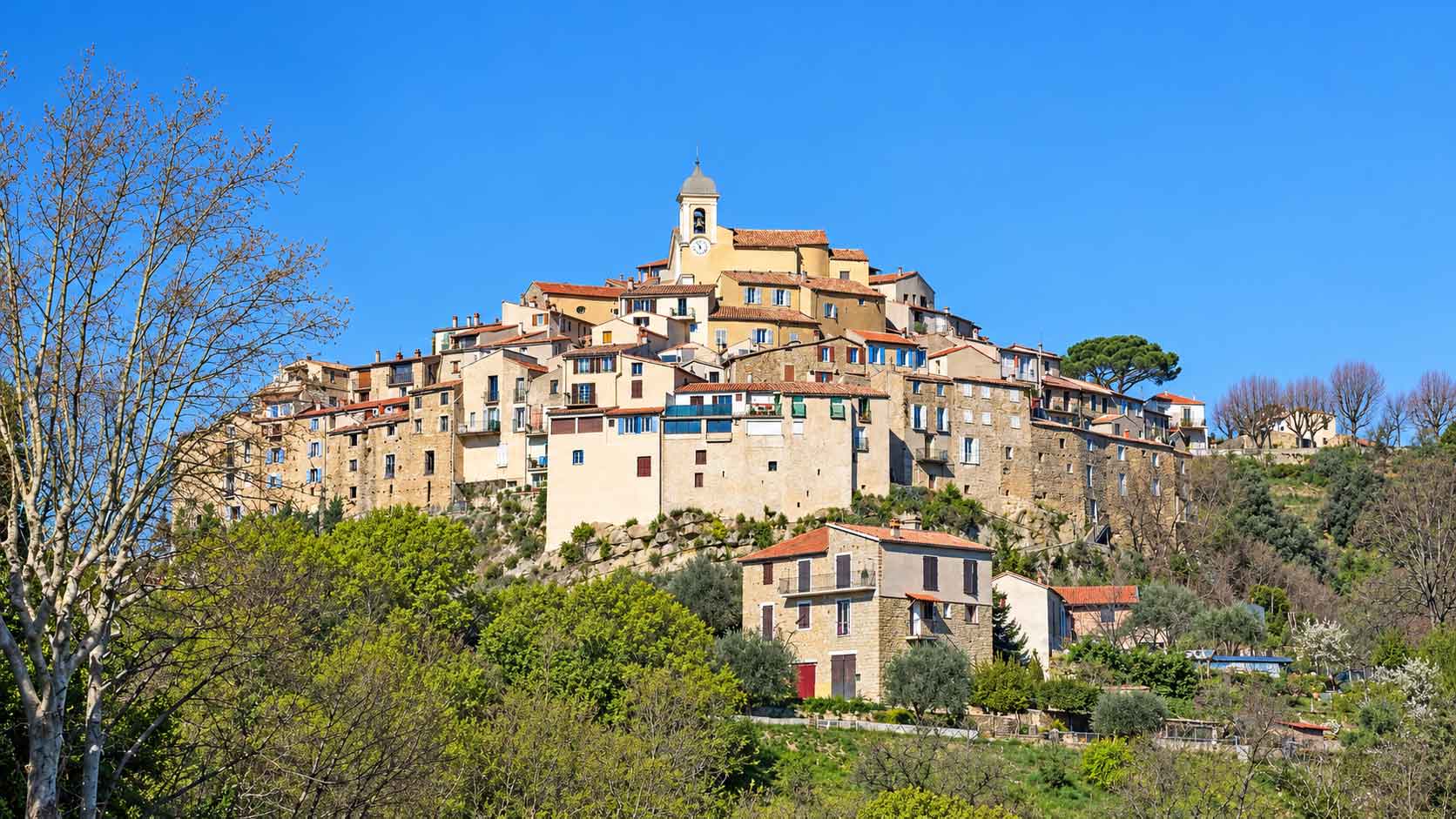
Berre-les-Alpes
Discover Berre-les-Alpes, a medieval hilltop village 700 metres above the Paillon valleys, with vaulted lanes, castle ruins, historic chapels, panoramic views and beautiful walks among olive trees, chestnuts and mimosa.
Berre-les-Alpes Travel Guide: A Panoramic Village Between the Mediterranean and the Mercantour
Berre-les-Alpes is a picturesque hilltop village in the Alpes-Maritimes, located approximately 22 kilometres from Nice in the Pays des Paillons. Built on a rocky height around 700 metres above sea level, the village overlooks the Paillon valleys and offers exceptional panoramic views extending from the Mediterranean coast to the mountains of the Mercantour.
Compact stone houses, narrow lanes, vaulted passages and the remains of a medieval castle give Berre-les-Alpes the appearance of a small mountain citadel. Around the village, olive groves gradually give way to chestnut forests, while pine trees and mimosa add colour and fragrance to the surrounding hills.
The historic centre contains the Church of Saint-Laurent, the Sainte-Croix Chapel, medieval castle ruins, an old communal oven and the vaulted underground Galeries du Presbytère. Berre-les-Alpes is also an excellent destination for walking, with routes leading through olive terraces, chestnut woods, streams and sandstone formations shaped by erosion.
In this Berre-les-Alpes travel guide:
- Best things to do in Berre-les-Alpes
- Explore the historic village
- Place Bellevue and panoramic views
- Church of Saint-Laurent
- Sainte-Croix Chapel
- Notre-Dame-des-Anges Chapel
- Medieval castle ruins
- Galeries du Presbytère
- The old communal oven
- Historic crosses and calvaries
- Walking and hiking
- Le Cloutet circuit
- Source du Brusch walk
- What to eat in Berre-les-Alpes
- Traditional events
- Best time to visit
- How to get to Berre-les-Alpes
- Getting there by public transport
- Parking and getting around
- One-day itinerary
- Places to visit nearby
- Frequently asked questions
Best Things to Do in Berre-les-Alpes
1. Explore the Historic Village
Begin your visit in the compact historic centre around Place Bellevue. From the square, a network of narrow streets, stairways and vaulted passages known locally as pontis extends between tightly grouped stone houses.
The layout of the village reflects its defensive medieval origins. A fortified settlement called Berre was already mentioned in written records in 1108, and a church was documented here in 1156. The village and its religious buildings were restored or reconstructed several times over the centuries.
Walk through Rue de l’Église, Rue du Baous, Rue de Conille and the lanes surrounding the former castle. Look for old doorways, covered passages, stone arches, small terraces and glimpses of the surrounding valleys between the houses.
The centre is compact but steep. Comfortable shoes are recommended, especially if you plan to combine the village visit with one of the surrounding walking routes.
2. Admire the View from Place Bellevue
Place Bellevue is the heart of Berre-les-Alpes and one of its principal viewpoints. The village occupies a natural promontory that offers a panoramic view of almost 360 degrees.
On clear days, the view extends towards the Férion range, Mont Agel, the Authion massif, Mont Bégo, the Argentera mountains and the Mediterranean Sea. The valleys below emphasise the dramatic position of the village on its rocky height.
The square is an excellent place to begin your visit, take photographs and understand the geography of the Pays des Paillons. Early morning and late afternoon generally offer the best light.
3. Visit the Church of Saint-Laurent
The Church of Saint-Laurent is the principal religious monument in Berre-les-Alpes. The parish has medieval origins, and the present building occupies the site of earlier churches.
The church was initially associated with Saint Valentine but was already recorded as dedicated to Saint Lawrence in the fourteenth century. It has been restored and modified on several occasions, with much of its present appearance resulting from nineteenth-century work.
The Renaissance-style façade dates from the nineteenth century, while the bell tower is topped by a distinctive dome. The stained-glass windows were designed by Clotilde Devillers and created during the restoration completed in 2004.
The church may not be open continuously. Access can depend on religious services, guided visits and local events. Visitors should dress respectfully and avoid disturbing ceremonies.
4. See the Sainte-Croix Chapel
The Sainte-Croix Chapel belonged to the White Penitents, a religious brotherhood whose members traditionally helped the sick, the poor and families in need.
The chapel stands opposite the parish church. This face-to-face arrangement between a parish church and a penitents’ chapel is considered unusual in the former County of Nice.
Its position makes the chapel an important part of the architectural composition of the historic centre. Opening hours can be limited, but its exterior can be seen while exploring the village.
5. Discover the Notre-Dame-des-Anges Chapel
The Notre-Dame-des-Anges Chapel is situated near the entrance to Berre-les-Alpes. It provides an attractive introduction to the religious and artistic heritage of the village.
The chapel was restored in 1996 by Ukrainian painter Alexandre Dubovik. Its interior contains colourful frescoes inspired by the Annunciation.
The building is not necessarily open every day. Ask at the Maison de Pays or town hall about possible visits and current opening arrangements.
6. See the Medieval Castle Ruins
The remains of the medieval castle occupy the upper part of the village near the church and presbytery. Although only sections survive, they recall the defensive role of Berre-les-Alpes during the Middle Ages.
From this strategic position, the settlement could monitor the surrounding ravines and routes through the Paillon valleys. Walls, masonry and the compact arrangement of the houses still give the village the appearance of a small fortified stronghold.
The ruins are integrated into the present village rather than organised as a separate archaeological attraction. Respect barriers, private property and unstable masonry.
7. Discover the Galeries du Presbytère
The Galeries du Presbytère form an unusual underground network beneath the church and former presbytery. Interlaced stone vaults and twisting passages create an atmospheric setting connected with the medieval and religious history of Berre-les-Alpes.
The galleries have been used as an exhibition space for painters and sculptors. Their historic stonework provides a dramatic background for temporary cultural events.
The official municipal website currently indicates that the galleries are closed for renovation work. Check their status before planning a visit specifically to see the interior.
8. See the Old Communal Oven
The old communal bread oven recalls a time when village families prepared their dough at home and brought it to a shared oven for baking.
The oven is still lit during certain traditional festivals and heritage events. These occasions allow visitors to experience a living element of rural community history rather than simply viewing an unused monument.
Festival dates and baking demonstrations change from year to year, so check the municipal programme before visiting.
9. Follow the Historic Crosses and Calvaries
Twelve crosses and calvaries have been identified across the commune of Berre-les-Alpes. Some are made of wrought iron, while others are cast iron or stand on carefully shaped sandstone bases.
These crosses marked roads, protected the entrances to the village and accompanied religious processions. Some were connected with prayers for protection against epidemics or for successful harvests.
They can be found near places such as Chemin de Conille, Colla Donna, Saint-Martin, Le Baous and Chemin des Combes. Together, they form a discreet heritage trail through the village and surrounding countryside.
Walking and Hiking Around Berre-les-Alpes
Berre-les-Alpes is surrounded by a varied landscape of olive groves, chestnut forests, pine woods, mimosa, streams and large sandstone rocks shaped by thousands of years of erosion.
The walking network includes short village circuits, family walks and longer routes connecting neighbouring hills, valleys and villages. Trails can be steep and rocky despite the relatively modest altitude.
Carry sufficient water, use proper walking shoes and avoid exposed trails during the hottest summer hours. In periods of high forest-fire risk, access to some natural areas may be restricted.
Le Cloutet Circuit
Le Cloutet is an accessible circular walk beginning at the village square. The route normally takes approximately two and a half hours.
It follows Rue du Chanoine Giaume, Rue du Baous and Rue de Conille before passing an old olive grove and descending towards the Brusc stream.
The route then climbs through oak woodland towards the Pointe du Cloutet. Walkers pass an old stone house, rural ruins, a historic water basin, chestnut trees, mimosa and pine forest before returning towards the village.
This walk provides an excellent overview of the landscapes surrounding Berre-les-Alpes and shows how areas that are now wooded were once cultivated and inhabited.
The Source du Brusch Walk
The Source du Brusch circuit begins at Place Bellevue and descends through chestnut woodland towards the old Brusch water basin, constructed in 1882.
This basin was the first drinking-water reservoir supplying the village. The return route follows a rocky ridge before entering Rue de Conille, Rue du Baous and Rue de l’Église.
The walk combines natural scenery, water heritage and the main historic monuments of Berre-les-Alpes. Check the current path condition before departure, particularly after storms or heavy rainfall.
La Pighiéra and Plan de Linéa
The La Pighiéra and Plan de Linéa routes explore the valleys and wooded slopes beyond the village. They pass streams, chestnut forests, rocky slabs, abandoned rural buildings and old bread ovens.
These routes are more demanding than a simple walk through the village. Carry a detailed map or GPS track and confirm the condition of the paths locally.
Col Saint-Roch
The route towards Col Saint-Roch passes through the Baisse de la Croix, Baisse de la Buse, Baisse de Marsan, Col du Savel and the forests around the Cime d’Auriéras.
This is a longer countryside itinerary suitable for experienced walkers. Weather, trail conditions and available daylight should be checked carefully before departure.
What to Eat in Berre-les-Alpes
The cuisine of Berre-les-Alpes combines Niçois and mountain traditions. The village stands near the altitude where olive groves gradually give way to chestnut forests, and both products are important to its local identity.
Regional specialities may include:
- Local olives and olive oil
- Chestnut cream and chestnut-based desserts
- Socca made from chickpea flour
- Pissaladière with onions, anchovies and olives
- Petits farcis, or stuffed Mediterranean vegetables
- Tourte de blettes in sweet or savoury form
- Daube niçoise served with pasta or polenta
- Ravioli and fresh pasta
- Local honey and seasonal fruit
Restaurants and shops are limited, and opening hours may vary outside the main season. Reservations are advisable for weekends and local festivals.
Traditional Events in Berre-les-Alpes
Village celebrations preserve the traditions and community life of Berre-les-Alpes. The annual programme may include:
- Saint Valentine and Mimosa Festival during winter
- Fête du Four, when the old communal oven may be used
- Saint-Laurent Festival, the principal patronal celebration in August
- Chestnut Festival during autumn
- Local markets, concerts, dances and heritage activities
Dates and programmes can change each year. Check the official municipal calendar before planning a visit around a specific festival.
Best Time to Visit Berre-les-Alpes
Late winter is the season for flowering mimosa, which brings yellow colour and fragrance to the surrounding hills.
Spring is one of the best periods for village walks and hiking. Temperatures are generally comfortable, and the vegetation is green and colourful.
Summer offers local festivals and long days, but exposed trails can become very hot. Visit the historic centre in the morning and walk in shaded forests later in the day.
Autumn is particularly attractive in the chestnut forests. The season also brings chestnut-related celebrations and cooler walking conditions.
Winter is generally peaceful. Occasional cold weather, frost or snow can affect higher roads and trails.
How to Get to Berre-les-Alpes
From Nice
Berre-les-Alpes is approximately 22 kilometres from Nice. The drive usually takes around 35 to 50 minutes, depending on traffic.
A common route follows the Paillon Valley through La Trinité, Drap and Contes before climbing to Berre-les-Alpes. Another approach passes through L’Escarène and the Col de Nice.
From Monaco
From Monaco, allow approximately 50 minutes to 1 hour 15 minutes by car, depending on traffic and the route selected.
You can travel via the A8 motorway and the Nice area before continuing through the Paillon Valley. A more scenic mountain route passes through La Turbie, Peille or L’Escarène, but it is narrower and usually slower.
From Contes
Berre-les-Alpes is a short drive from Contes. Allow approximately 15 to 20 minutes for the winding uphill road.
From L’Escarène
The village can also be reached from L’Escarène by crossing the Col de Nice. The drive takes approximately 15 to 20 minutes and follows a scenic mountain road.
From Cannes or Antibes
From Cannes or Antibes, allow approximately 1 hour 15 minutes to 1 hour 40 minutes, depending on motorway traffic around Nice.
Getting There by Public Transport
Berre-les-Alpes is served by the regional ZOU! bus network.
- Line 612 connects La Grave de Contes with Berre-les-Alpes.
- Line 610 connects Nice with La Grave de Contes, where passengers can change for line 612.
- Some school services connect Berre-les-Alpes with L’Escarène, but they should not be treated as regular tourist transport.
Services may be limited during weekends, school holidays and public holidays. Check the current ZOU! timetable, connection time at La Grave de Contes and the last return bus before travelling.
The nearest railway station is at L’Escarène on the Nice–Breil-sur-Roya railway line. However, there is no frequent direct connection from the station to the village, so continuing by taxi may be necessary.
Parking and Getting Around
Public parking is available near the entrances to the village, including spaces around the lower part of the centre and the Baous area.
The historic centre is best explored on foot. Its streets are narrow, steep and unsuitable for through traffic. Follow local signs and avoid entering restricted lanes.
Some spaces may fill quickly during festivals and weekends. Arrive early and never block residents’ entrances, emergency access or turning areas.
The village includes stairs, steep slopes and uneven paving. Visitors with reduced mobility may find some parts of the historic centre difficult to access.
One-Day Itinerary in Berre-les-Alpes
Morning
Begin at Place Bellevue and admire the panorama extending from the Paillon valleys towards the Mediterranean and the Mercantour.
Explore the historic streets and vaulted passages, then visit the Church of Saint-Laurent, the Sainte-Croix Chapel, the medieval castle ruins and the old communal oven.
See the entrance to the Galeries du Presbytère and visit them if they have reopened and an exhibition is taking place.
Lunch
Have lunch in the village or prepare a picnic with products from the Pays des Paillons. Confirm restaurant opening hours in advance.
Afternoon
Choose the Le Cloutet circuit for a walk of approximately two and a half hours through olive groves, oak woodland, chestnut trees, mimosa and pine forest.
For a shorter visit, follow part of the Source du Brusch route or drive to the Notre-Dame-des-Anges Chapel before continuing towards L’Escarène or Contes.
Places to Visit Near Berre-les-Alpes
Contes
Contes is the principal town of the Paillon Valley. It offers an old centre, religious heritage, shops, restaurants and useful services.
Coaraze
Coaraze is a beautiful perched village known for its sundials, stone streets, colourful façades and extensive mountain views.
L’Escarène
L’Escarène has a historic centre built around the Paillon River, with Baroque churches, traditional houses and a station on the scenic Nice–Breil-sur-Roya railway line.
Lucéram
Lucéram is a medieval village with old gates, chapels, stone lanes and a popular Christmas nativity-scene circuit.
Peillon
Peillon is one of the most dramatic perched villages near Nice. Its stone houses and narrow passages appear to cling to a steep rocky slope.
Châteauneuf-Villevieille
The ruins of the abandoned medieval village of Châteauneuf-Villevieille occupy a panoramic ridge and provide an atmospheric destination for walkers interested in history.
Bendejun
Bendejun is known as the Village of Springs. Its quiet centre, old church, olive terraces and countryside paths make it an easy addition to a tour of the Pays des Paillons.
Frequently Asked Questions About Berre-les-Alpes
Is Berre-les-Alpes worth visiting?
Yes. The village offers medieval character, exceptional panoramic views, historic religious buildings and several attractive walking routes away from the busy Riviera coast.
How much time do you need in Berre-les-Alpes?
Allow two to three hours for the historic centre and viewpoints. A full day is recommended if you also want to complete a countryside walk.
What is the altitude of Berre-les-Alpes?
The historic village stands at approximately 700 metres above sea level.
Can you visit Berre-les-Alpes without a car?
Yes. ZOU! line 612 connects the village with La Grave de Contes, where passengers can transfer to line 610 for Nice. Timetables should be checked carefully.
Are the Galeries du Presbytère open?
The official municipal website currently states that the galleries are closed for renovation work. Check with the town hall or Maison de Pays for the latest information.
Is Berre-les-Alpes suitable for families?
The historic centre and shorter walks can be suitable for families, although streets and paths are steep. Children should be supervised near castle ruins, roads and exposed viewpoints.
What is the best easy hike?
Le Cloutet is described by the municipality as an easy walk taking approximately two and a half hours. It begins in the village and passes olive groves, woodland, streams and rural ruins.
Where can you obtain tourist information?
Local information is available from the Maison de Pays and Berre-les-Alpes Town Hall. Ask about guided visits, exhibitions, walking routes and current access conditions.
City Gallery