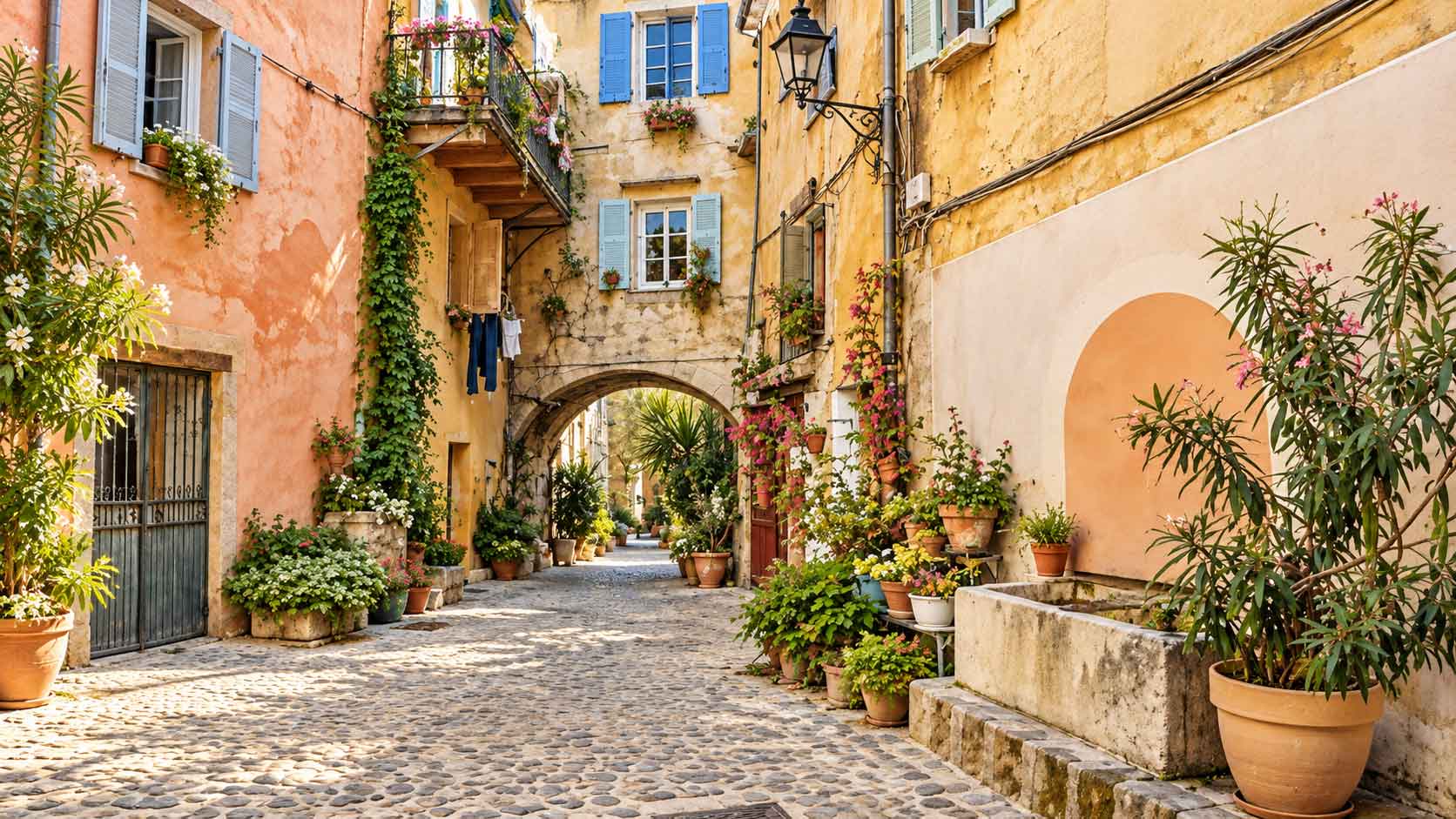
Bendejun
Discover Bendejun, the peaceful “Village of Springs” in the Pays des Paillons, with historic churches, medieval lanes, olive terraces, wooded hills and panoramic walks overlooking the Paillon Valley.
Bendejun Travel Guide: The Village of Springs in the Pays des Paillons
Bendejun is a peaceful hill village in the Alpes-Maritimes, located in the Pays des Paillons between Nice, Contes and Coaraze. Spread across green hills at the foot of Mont Férion, the village is surrounded by olive trees, orchards, chestnut groves, Mediterranean vegetation and old agricultural terraces.
Traditionally known as the “Village of Springs”, Bendejun developed in an area rich in natural water and irrigation channels. This abundance of water supported gardens, fruit trees and agricultural activity for generations.
Bendejun is not a fortified hilltop village concentrated inside a single enclosure. Its houses, hamlets and historic buildings are distributed along the roads and across the surrounding slopes. This gives the commune a rural, spacious and authentic character.
The main reasons to visit Bendejun are its tranquil atmosphere, historic parish church, old chapel known as the Gleia Vielha, traditional lanes, panoramic viewpoints and walking routes through the hills of the Pays des Paillons.
In this Bendejun travel guide:
- Best things to do in Bendejun
- Explore the historic centre
- Visit the parish church
- Discover the Gleia Vielha
- Ruins of the Chapelle San Bénédé
- The Crestan ruins and viewpoints
- Springs, gardens and agricultural terraces
- Traditional houses and country residences
- Walking and hiking around Bendejun
- What to eat in Bendejun
- Traditional events
- Best time to visit
- How to get to Bendejun
- Getting there by public transport
- Parking and getting around
- One-day itinerary
- Places to visit nearby
- Frequently asked questions
Best Things to Do in Bendejun
1. Explore the Historic Centre
Begin your visit around Place du Centenaire, the town hall and the parish church. This area forms the administrative and social centre of Bendejun and provides access to the narrow streets of the old village.
The historic centre preserves a network of small lanes, stairways and pedestrian passages inherited from earlier periods. Traditional houses are generally two or three storeys high and stand close together on the slopes.
Unlike the more densely fortified villages of the Riviera hinterland, Bendejun gradually expanded across several hamlets and hillsides. Walk slowly through the village to appreciate its fountains, stone walls, garden entrances, old façades and views towards the Paillon Valley.
Place du Centenaire is also used for local gatherings and traditional celebrations. It is a pleasant place to begin or finish a walk through the village.
2. Visit the Parish Church
The parish church stands at the heart of modern Bendejun. It is associated with Notre-Dame-du-Rosaire and Saint Benedict, the historic patron of the community.
The earlier parish church eventually became too small and was in poor condition. A new church was therefore constructed and inaugurated in 1868. Its tall bell tower is one of the most recognisable features of the village skyline.
The church contains religious furniture, statues and devotional objects connected with the spiritual history of Bendejun. One notable element is the nineteenth-century votive statue of Saint Roch, a saint traditionally invoked for protection against disease.
Opening hours may depend on religious services, local events or arrangements with the municipality and parish. Visitors should dress respectfully and avoid disturbing services.
3. Discover the Gleia Vielha
The Gleia Vielha, meaning “Old Church” in the local language, is one of the most important historic buildings in Bendejun. It stands near Place Théophile Bermond in the lower part of the village.
Originally a chapel dedicated to Notre-Dame-du-Rosaire, it became the parish church of Bendejun in 1622. This allowed local inhabitants to attend services without travelling to the distant parish church of Châteauneuf-Villevieille.
The building served the community for almost three centuries. It was eventually replaced by the larger parish church inaugurated in 1868.
The old church has a restrained classical façade, a carved lintel and a distinctive triangular bell gable decorated with coloured roof tiles. It has been deconsecrated and is now used as a cultural and exhibition space.
Access depends on the programme of exhibitions, concerts, conferences and community events. The exterior can still be viewed when the building is closed.
4. Walk to the Ruins of the Chapelle San Bénédé
The ruins of the Chapelle San Bénédé recall the oldest religious history of Bendejun. The place name appears in medieval records connected with Saint Benedict and the Benedictine abbey of Saint-Pons in Nice.
The ruins stand away from the present centre and can be reached during a countryside walk. The site offers an opportunity to combine local history with views over the hills and Paillon Valley.
These are fragile remains rather than a restored visitor attraction. Wear suitable shoes, remain on recognised paths and do not climb on unstable walls.
5. Discover the Crestan Ruins and Panoramic Views
The Crestan area is another historic site located on the heights around Bendejun. Together with the San Bénédé ruins, it provides extensive views across the Paillon Valley and the surrounding hills.
The position helps visitors understand the long history of settlement in the area. A place called Bendejun was already mentioned in written records in 1030, and archaeological evidence indicates even earlier occupation.
A small fortification appears to have existed during the early thirteenth century, although it was recorded as destroyed by 1252. Settlement later developed again during the sixteenth century.
Paths in this area may be uneven, overgrown or exposed to the sun. Check local conditions and avoid entering private land.
Springs, Gardens and Agricultural Terraces
Bendejun’s identity is closely connected with water. The commune is traditionally called the Village of Springs because numerous natural sources and irrigation channels supplied its homes, gardens and farmland.
The hillsides were shaped into terraces, known locally as restanques, supported by dry-stone walls. These terraces made it possible to cultivate sloping land and retain soil and water.
Olive trees, fruit orchards, vegetables and other crops once played an important role in the local economy. Many historic terraces and irrigation features can still be observed around the village.
The surrounding vegetation includes olive trees, chestnuts, broom, laurel, thyme and other plants characteristic of the Mediterranean hinterland. Spring is particularly attractive, when the countryside becomes greener and wildflowers appear along the paths.
Respect cultivated land and private gardens. Water can be scarce during dry periods, despite the village’s historic association with springs, and regional water restrictions may apply during droughts.
Traditional Houses and Country Residences
Bendejun combines modest rural architecture with several larger residences built for wealthy families from Nice. From the late nineteenth century, the village became appreciated as a place for summer holidays away from the heat of the coast.
Country residences and villas were constructed among the gardens and hillsides. Some properties are associated with notable local families, including the Raiberti family.
Most of these buildings are private and cannot be visited. They should be appreciated from public roads without entering the grounds or disturbing residents.
The mixture of closely grouped village houses, isolated villas, orchards and agricultural terraces gives Bendejun a distinctive landscape unlike that of the more compact perched villages nearby.
Walking and Hiking Around Bendejun
Bendejun lies within the Pays des Paillons, a territory offering hundreds of kilometres of paths between valleys, ridges, forests, hamlets and historic villages.
Walkers can explore the countryside around the San Bénédé and Crestan ruins, follow paths between old terraces or continue towards neighbouring communes such as Coaraze and Châteauneuf-Villevieille.
Short Walk Around the Village
For an easy visit, start near Place du Centenaire, explore the historic centre and parish church, then descend towards the Gleia Vielha. Continue along the quieter lanes to see gardens, terraces and views over the Paillon Valley.
Walk to San Bénédé and Crestan
A longer walk can include the ruins of San Bénédé and the Crestan area. The precise route should be confirmed locally because paths, access points and vegetation can change.
Towards Mont Férion
Experienced walkers can explore the wider network of routes towards the foothills of Mont Férion. These itineraries may involve significant elevation gain and should not be confused with a short village walk.
Carry water, wear proper walking shoes and avoid exposed hillsides during the hottest summer hours. After heavy rain, some paths can become muddy or unstable.
During periods of high forest-fire risk, access to woodland and mountain areas may be restricted. Check the current departmental regulations before setting out.
What to Eat in Bendejun
The cuisine around Bendejun reflects the traditions of Nice and the rural Pays des Paillons. It is based on olive oil, seasonal vegetables, herbs, local cheese and recipes influenced by both Provence and nearby Piedmont.
Regional specialities may include:
- Olives and locally produced olive oil
- Pissaladière with onions, olives and anchovies
- Socca made with chickpea flour
- Petits farcis, or stuffed Mediterranean vegetables
- Tourte de blettes in sweet or savoury form
- Daube niçoise served with pasta or polenta
- Ravioli and other fresh pasta
- Seasonal fruit, chestnuts and local honey
The village has limited dining and shopping options. Check opening times before visiting and consider combining lunch with a stop in Contes, Coaraze or another village in the Pays des Paillons.
Traditional Events in Bendejun
The main traditional celebration is the Festin de la Saint-Benoît, usually organised during the summer. The festival brings residents and visitors together for meals, music, entertainment and community activities around Place du Centenaire.
Additional exhibitions, concerts and cultural events may be organised in the Gleia Vielha or other municipal spaces.
Dates and programmes vary each year. Check the official municipal calendar before planning a visit specifically for an event.
Best Time to Visit Bendejun
Spring is one of the best seasons for exploring Bendejun. The countryside is green, temperatures are comfortable and Mediterranean plants are in bloom.
Summer is lively and suitable for local festivals, but afternoons can be very hot. Walk early in the morning or later in the day and carry enough water.
Early autumn offers mild temperatures, quieter roads and good conditions for walking through the surrounding countryside.
Winter is generally peaceful and allows visitors to experience the village without crowds. Some services and cultural sites may operate on reduced schedules.
How to Get to Bendejun
From Nice
Bendejun is located approximately 25 kilometres north-east of Nice. The drive usually takes around 35 to 50 minutes, depending on traffic.
From Nice, travel towards La Trinité and Drap, then continue through the Paillon Valley towards Contes. From the Contes area, follow the signs for Bendejun and Coaraze.
From Monaco
From Monaco, allow approximately 50 minutes to 1 hour 15 minutes by car, depending on traffic and the chosen route.
A common itinerary follows the A8 motorway towards Nice before continuing inland through La Trinité, Drap and Contes. Alternative mountain routes may be scenic but are generally narrower and slower.
From Contes
Bendejun is only a short drive from Contes. The journey normally takes around 10 minutes, making it easy to combine both villages in the same excursion.
From Coaraze
Coaraze lies farther along the same valley route. The journey between Coaraze and Bendejun generally takes around 10 to 15 minutes.
From Cannes or Antibes
From Cannes or Antibes, allow approximately 1 hour 10 minutes to 1 hour 30 minutes, depending on motorway traffic around Nice.
Getting to Bendejun by Public Transport
Bendejun is served by the regional ZOU! bus network. The principal service is line 613, which connects La Grave de Contes, Bendejun and Coaraze.
At La Grave de Contes, passengers can connect with line 610 for travel towards Nice. Some services may continue or provide scheduled connections with Nice, Drap and local schools.
Bus frequency is limited compared with the coast. Services may not operate on Sundays and public holidays, and certain journeys run only during school periods.
Always check the current ZOU! timetable, connection time and final return service before travelling. Arrive at the stop several minutes before the scheduled departure.
Parking and Getting Around
Parking spaces are available around the village centre and near the main public facilities. As the old lanes are narrow, it is best to leave the car in an authorised parking area and continue on foot.
The centre is compact but includes slopes, steps and uneven surfaces. Comfortable shoes are recommended.
Some historic sites, villas and ruins are located outside the centre. A combination of driving and walking may therefore be necessary to explore the wider commune.
Never block private entrances, narrow roads or emergency access. When walking outside the village, respect private land, cultivated terraces and local signage.
One-Day Itinerary in Bendejun
Morning
Begin near Place du Centenaire and explore the heart of the village. Visit the parish church if it is open, then walk through the narrow lanes and observe the traditional houses, gardens and surrounding terraces.
Continue towards Place Théophile Bermond to see the Gleia Vielha. If an exhibition or cultural event is taking place, visit the interior of the former parish church.
Lunch
Have lunch in the Pays des Paillons or prepare a picnic with local products. Confirm restaurant opening hours in advance, especially outside the summer season.
Afternoon
Choose a countryside walk towards the San Bénédé ruins or the Crestan area. Enjoy the views over the Paillon Valley and observe the olive terraces and Mediterranean vegetation.
Alternatively, continue by car to Coaraze, Contes or the ruins of Châteauneuf-Villevieille.
Places to Visit Near Bendejun
Coaraze
Coaraze is a beautiful perched village known for its stone lanes, sundials, colourful architecture and extensive views over the surrounding mountains.
Contes
Contes is the principal town of the valley and offers historic streets, religious heritage, shops and services. It is a convenient place to stop for lunch or supplies.
Châteauneuf-Villevieille
The ruins of the abandoned medieval village of Châteauneuf-Villevieille occupy a ridge above the surrounding valleys. The site combines history, stone ruins and panoramic views.
Berre-les-Alpes
Berre-les-Alpes is a compact hilltop village with narrow lanes and viewpoints over the Paillon Valley and surrounding peaks.
Peillon
Peillon is one of the most dramatic perched villages near Nice. Its stone houses and lanes appear to cling to a steep rocky hillside.
L’Escarène
L’Escarène has a historic centre, Baroque churches and traditional houses built around the Paillon River. It is also an important stop on routes towards the Col de Braus and Lucéram.
Lucéram
Lucéram is a medieval village known for its old streets, chapels and annual Christmas nativity-scene circuit.
Frequently Asked Questions About Bendejun
Is Bendejun worth visiting?
Yes, particularly for travellers interested in quiet villages, local heritage, countryside walks and destinations away from the busiest Riviera tourist routes.
How much time do you need in Bendejun?
Allow two to three hours to explore the centre, parish church and Gleia Vielha. A full day is suitable if you also want to walk to the ruins or visit nearby villages.
Why is Bendejun called the Village of Springs?
The commune was historically supplied by numerous natural springs and irrigation channels. This water supported its gardens, orchards, olive groves and agricultural terraces.
What is the Gleia Vielha?
The Gleia Vielha is the former parish church of Bendejun. Originally a chapel dedicated to Notre-Dame-du-Rosaire, it became a parish church in 1622 and is now used as a cultural and exhibition space.
Can you visit Bendejun without a car?
Yes. ZOU! line 613 serves Bendejun from La Grave de Contes and Coaraze, with connections towards Nice. However, services are limited and the timetable must be checked carefully.
Is Bendejun suitable for families?
The village centre and short countryside walks can be suitable for families. Children should be supervised near roads, steep paths and ruined structures.
Are the San Bénédé and Crestan ruins restored attractions?
No. They are historic remains in the countryside rather than organised visitor attractions. Access conditions can vary, and visitors should not climb on fragile walls.
Where can you obtain local information?
Information about municipal services, events and local access can be obtained from Bendejun Town Hall, located at 2 Place du Centenaire, 06390 Bendejun.
City Gallery