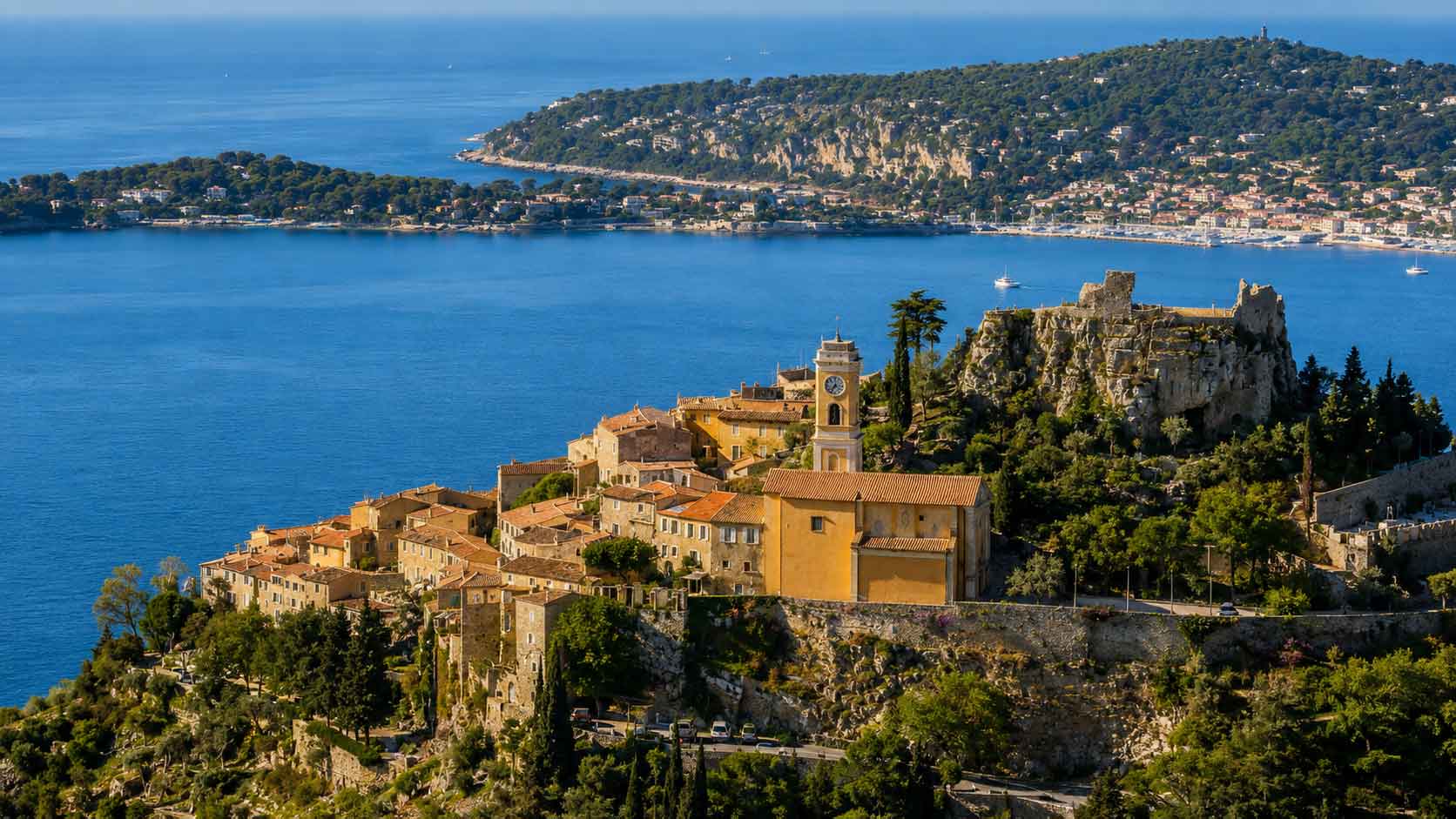
Èze
Discover the best things to do in Èze, a medieval hilltop village between Nice and Monaco: the Exotic Garden, stone lanes, Notre-Dame-de-l’Assomption Church, Nietzsche Path, perfume houses and the beaches of Èze-sur-Mer.
Visiting Èze means discovering one of the most famous hilltop villages on the French Riviera. Located between Nice and Monaco, Èze overlooks the Mediterranean from a spectacular rocky promontory. Its medieval lanes, Exotic Garden, panoramic views and Nietzsche Path make it an essential Côte d’Azur destination.
If you are looking for the best things to do in Èze, how to reach the village or how much time you need, this SAVÙ travel guide will help you plan your visit. Discover Èze Village, the Exotic Garden, Notre-Dame-de-l’Assomption Church, Sainte-Croix Chapel, the perfume houses, Nietzsche Path and Èze-sur-Mer.
Best Things to Do in Èze
1. Explore the medieval village of Èze
Èze Village stands on a rocky promontory high above the Mediterranean. Its historic center is entirely pedestrianized and can be explored through a network of cobbled lanes, vaulted passages, stairways and small squares.
After passing through the fortified entrance, follow the lanes as they gradually climb toward the summit. The stone houses now contain art galleries, craft workshops, shops, hotels and restaurants.
The village is relatively small, but its numerous passages and viewpoints invite visitors to explore slowly. The combination of historic stone buildings, Mediterranean plants and sea views creates the distinctive atmosphere for which Èze is famous.
SAVÙ tip: arrive before 9:00 a.m. or visit toward the end of the afternoon to enjoy quieter streets. The village can become very crowded between late morning and mid-afternoon, especially during summer.
2. Visit the Exotic Garden of Èze
The Exotic Garden occupies the highest part of the village on the site of the former castle ruins. It overlooks the Mediterranean from an altitude of approximately 429 meters.
The garden contains cacti, agaves, aloes, euphorbias and many succulent plants adapted to the dry climate. They grow among rocks, castle remains and sculptures.
From the upper terraces, the view extends across the coastline, Saint-Jean-Cap-Ferrat, the Mediterranean and the mountains surrounding Èze. In clear weather, it is one of the most impressive panoramas on the French Riviera.
Admission to the Exotic Garden is charged. Opening hours and ticket prices vary according to the season. Check the official information and consider purchasing your ticket in advance during busy periods.
The garden contains steps, slopes and uneven passages. Wear comfortable footwear and bring sun protection during summer.
3. Enjoy the view from the castle ruins
The remains at the top of the Exotic Garden belong to the former fortified castle of Èze. The castle was destroyed in 1706 on the orders of Louis XIV during the War of the Spanish Succession.
No complete castle survives, but its ruins create a dramatic setting above the Mediterranean. Orientation tables and several viewpoints help visitors identify the surrounding coastline and mountains.
The panorama changes throughout the day. Morning light often reveals more detail along the coast, while the late afternoon brings warmer colors to the village stonework.
4. See Notre-Dame-de-l’Assomption Church
Notre-Dame-de-l’Assomption Church stands immediately below the Exotic Garden. Its ochre and yellow façade is easily recognizable within the village landscape.
The present building was constructed between 1764 and 1778 on the site of an earlier church. Its architecture is associated with the regional Baroque style, while its square bell tower was completed during the 19th century.
The interior contains several religious artworks. Access may depend on services, ceremonies and opening hours. Respect the silence and people who have come to pray.
5. Discover Sainte-Croix Chapel
Sainte-Croix Chapel is associated with the White Penitents Brotherhood of Èze, founded in 1306. Members of the brotherhood provided assistance to the sick, the poor and people affected by epidemics.
This small chapel is one of the principal religious landmarks in the medieval village. It is also known as the Chapel of the White Penitents.
The interior is not necessarily open every day, but its exterior architecture is worth seeing while exploring the village lanes.
6. Notice the historic gates, passages and houses
Much of the charm of Èze lies in its details. Take time to notice the historic doors, signs, stone walls, covered passages and small openings overlooking the Mediterranean.
The Poterne gate recalls the village’s former defensive system. During the Middle Ages, Èze was protected by fortifications because of its strategic position between Nice and Monaco.
The lanes still preserve the names of historic families and the compact layout typical of a fortified hilltop village.
7. Discover the galleries and craft workshops
Many houses in the historic center now contain galleries, workshops, jewelry designers, craft shops and interior decoration boutiques.
These businesses contribute to the village’s contemporary identity. Some creations are directly inspired by the Mediterranean, the plants of the Exotic Garden and the landscapes of the French Riviera.
Compare the shops and give preference to pieces genuinely created or designed by local artists and craftspeople.
8. Visit the perfume houses of Èze
Èze has perfume houses and visitor centers dedicated to the production of fragrances and cosmetics. Fragonard and Galimard are among the companies present in the commune.
Depending on the establishment and season, guided tours, demonstrations and fragrance workshops may be available. These experiences introduce visitors to raw materials and the different stages involved in creating perfume.
Opening hours, tour languages and reservation requirements vary. Contact the perfume houses directly before your visit.
9. Photograph Èze from the Corniche roads
The commune of Èze extends from the Mediterranean to the mountains and is crossed by three historic roads: the Lower, Middle and Upper Corniche.
The Middle Corniche provides several famous views of the hilltop village. However, stopping outside designated areas is dangerous because the road is narrow and busy.
Use only official viewpoints, sidewalks and parking areas. Never stand or walk in the road to take photographs.
10. Walk the Nietzsche Path
The Nietzsche Path connects Èze-sur-Mer with the medieval village. The steep trail is named after German philosopher Friedrich Nietzsche, who began spending time on the French Riviera in 1883.
Nietzsche walked in the hills around Èze and connected walking with his creative work. Part of Thus Spoke Zarathustra is traditionally associated with this period and his climbs toward the village.
The route is approximately 2.1 kilometers long and gains nearly 400 meters in elevation. The climb usually takes between one hour and one and a half hours, depending on fitness, heat and the number of stops.
The path includes steps, stones, steep slopes and sections exposed to direct sunlight. It is not a simple urban walk.
11. Swim at Èze-sur-Mer
Èze-sur-Mer, also known as Èze Bord de Mer, lies below the cliffs. This district has a railway station, beach, restaurants and several properties surrounded by Mediterranean vegetation.
Èze Beach consists mainly of pebbles. Its clear water and location between the sea and mountains create a very different setting from the hilltop village.
Bring water shoes and remain cautious when the sea is rough. Lifeguard supervision, services and restaurants depend on the season.
12. Discover Mont Bastide and the Upper Corniche
Mont Bastide overlooks the Mediterranean from an altitude of more than 500 meters. The area preserves traces of ancient Celto-Ligurian, Roman and Gallo-Roman occupation.
Its hiking trails offer views of Èze, Cap-Ferrat, the Mediterranean and the landscapes surrounding the Upper Corniche. These paths are wilder and generally less crowded than the village lanes.
A detailed map, proper footwear and sufficient drinking water are essential. Check the condition of the trails and any restrictions affecting access to natural areas before departure.
The History of Èze
The earliest traces of human occupation within the territory of Èze date back to prehistoric times. Celto-Ligurian communities later settled on the heights of Mont Bastide, where they constructed a fortified settlement.
The territory was subsequently occupied by Romans and Gallo-Romans. The name Èze may be connected with the ancient port of Avisio, mentioned in an old maritime itinerary, although its precise origin remains uncertain.
During the 10th century, the region was occupied by Saracens. The first known written reference to the name Èze appears in a document from Saint-Pons Abbey in Nice dated 1075.
During the Middle Ages, the village developed around its castle and fortifications. Its elevated position made it possible to monitor the coastline and the routes connecting Nice, Villefranche and Monaco.
From 1388, Èze belonged to the House of Savoy. Its fortifications and entrances were strengthened because of the strategic importance of the County of Nice.
In 1543, the village was occupied by Franco-Ottoman forces during the conflict involving Francis I, Suleiman the Magnificent and Charles V.
In 1706, during the War of the Spanish Succession, Louis XIV ordered the destruction of the castle and part of the defensive walls to remove this strategic position between Villefranche and Monaco.
Èze became permanently part of France in 1860 together with the County of Nice. The arrival of the railway and construction of the Corniche roads later encouraged the development of Èze-sur-Mer and tourism.
Writers, artists, musicians and other personalities were gradually attracted by the village’s light and landscapes. Friedrich Nietzsche played a particularly important role in the cultural reputation of Èze.
How to Walk the Nietzsche Path
Starting from Èze-sur-Mer
The lower trailhead is located near Èze-sur-Mer, a short distance from the railway station. The path climbs toward the village through Mediterranean vegetation and rocky terrain.
This direction is the most demanding because it involves approximately 400 meters of ascent. Start early, especially between June and September.
Descending from Èze Village
You can also follow the trail downhill from the village. The upper trailhead is located close to Avenue du Jardin Exotique.
The descent is less demanding on the cardiovascular system, but it places considerable pressure on the knees and can be slippery. Proper walking shoes are still essential.
Safety advice
- Wear hiking shoes or sports shoes with good grip.
- Carry enough water because the path is highly exposed to the sun.
- Avoid climbing during the hottest part of the day.
- Do not use the trail during thunderstorms or heavy rain.
- The trail is strongly discouraged for very young children.
- Do not expect continuous shade along the route.
- Check the current condition of the trail before departure.
One practical itinerary is to take a bus to Èze Village, explore the village and then descend along the Nietzsche Path to Èze-sur-Mer railway station. Check trail conditions and train times before choosing this route.
Best Things to Do in Èze-sur-Mer
Èze-sur-Mer has a quieter and more residential atmosphere than the hilltop village. The district developed around the railway, beach and several historic villas.
You can relax on the beach, have lunch beside the Mediterranean, explore part of the coastline or begin the climb along the Nietzsche Path.
The railway station provides convenient connections with Nice, Monaco, Menton and other coastal destinations. However, it does not directly serve Èze Village, which stands several hundred meters above the coast.
Do not plan to walk from the railway station to the village along the road. Use the Nietzsche Path only if you are equipped for a demanding hike, or choose appropriate road transportation.
Best Hikes Around Èze
Nietzsche Path
This is the best-known hike in the commune. It connects the coast with the village over approximately 2.1 kilometers and nearly 400 meters of elevation gain.
Mont Bastide
Mont Bastide combines hiking, panoramic landscapes and archaeological remains. The route provides impressive views of the village, the Mediterranean and Saint-Jean-Cap-Ferrat.
Upper Corniche trails
Several paths cross the hills above Èze and connect mountain passes, viewpoints and protected natural areas within the Upper Corniche departmental park.
Choose an itinerary appropriate for your experience and use a recent map. During summer, access to natural areas may be restricted or prohibited because of wildfire risk.
How to Visit Èze in Half a Day or One Day
Visiting Èze in half a day
Arrive early and begin with the lanes of the medieval village. See Sainte-Croix Chapel, Notre-Dame-de-l’Assomption Church and the craft shops.
Continue to the Exotic Garden and allow time for the plants, castle ruins and panoramic views. Finish with a perfume house visit or lunch near the village.
Visiting Èze in one day
Devote the morning to the village and Exotic Garden. After lunch, travel to Èze-sur-Mer or walk the Nietzsche Path if your fitness level and the weather permit.
Finish the day on the beach before returning by train toward Nice, Monaco or Menton.
A full day without hiking
If you do not want to use the Nietzsche Path, visit the village during the morning, have lunch and then reach Èze-sur-Mer using suitable transportation.
Another option is to combine Èze Village with La Turbie, Cap-d’Ail, Monaco or Villefranche-sur-Mer.
Best Time to Visit Èze
- Spring brings pleasant temperatures, colorful plants and generally favorable hiking conditions.
- Summer is very busy, and the Nietzsche Path can become extremely hot. Arrive early.
- Early fall often provides warm sea temperatures with gradually decreasing visitor numbers.
- Winter offers quieter lanes, but days are shorter and some establishments may reduce their opening hours.
April, May, June, September and early October generally offer the best balance of weather, light and visitor numbers.
How to Get to Èze
Getting to Èze Village by bus
Buses connect Èze Village with Nice, Monaco and neighboring communes. This is often the most convenient way to visit without searching for a parking space.
Route numbers, stops and service frequency may change. Check the official schedules on the day of your visit, especially on Sundays and public holidays.
Getting to Èze-sur-Mer by train
Èze-sur-Mer railway station is located on the coastal line connecting Nice, Monaco, Menton and Ventimiglia. It is convenient for the beach and the lower trailhead of the Nietzsche Path.
Important: the railway station is not close to the medieval village. Èze Village stands approximately 400 meters above it.
Getting to Èze by car
Èze Village is located along the Middle Corniche between Nice and Monaco. The road provides beautiful views but is narrow, winding and often busy.
Expect congestion during summer, weekends and peak commuting hours. Never stop in the road to photograph the village.
Where to Park in Èze
Paid parking facilities are available near the entrance to Èze Village. Their capacity is limited compared with the number of visitors.
During the high season, arrive early in the morning or use public transportation. Check prices, closing hours and height restrictions before entering.
Do not park on roadside verges, in front of private properties or on roads required by buses and emergency vehicles.
Parking is also limited in Èze-sur-Mer. The train is often the best option for reaching the beach.
Where to Stay and Eat in Èze
Staying in Èze Village
The village has boutique and luxury hotels offering spectacular views. Staying overnight allows you to experience the lanes early in the morning and during the evening after most day visitors have left.
Staying in Èze-sur-Mer
Èze-sur-Mer is suitable for travelers who want to remain close to the beach and use the train to explore the French Riviera.
Where to eat in Èze
The village contains gourmet restaurants, hotel restaurants, cafés and more casual establishments. Prices are generally higher inside the village and at properties offering panoramic views.
Check the menu before choosing a table and make reservations for the best-known restaurants. Tables fill quickly during busy tourist periods.
Places to Visit Around Èze
- La Turbie: a village known for the Trophy of Augustus and panoramic views over Monaco.
- Cap-d’Ail: beaches, coves and a coastal path beside Monaco.
- Monaco: the Prince’s Palace, old town, harbor, Monte-Carlo Casino and museums.
- Beaulieu-sur-Mer: a harbor, beaches and Villa Kérylos.
- Saint-Jean-Cap-Ferrat: coastal trails, coves and Villa Ephrussi de Rothschild.
- Villefranche-sur-Mer: a colorful old town, citadel and deep natural bay.
- Nice: the Promenade des Anglais, Old Nice, markets and museums.
- Roquebrune-Cap-Martin: a medieval village, castle and coastal walks.
- Menton: gardens, a historic old town and colorful architecture near the Italian border.
For a balanced day trip, combine Èze with only one additional destination. Coastal roads can be slow, and the village deserves several hours.
Tips for Visiting Èze Responsibly
- Use buses and trains whenever possible.
- Respect the peace and privacy of village residents.
- Do not block lanes, doors or private entrances.
- Take your rubbish with you and use the designated collection points.
- Remain on marked trails while hiking.
- Do not pick plants in the Exotic Garden or natural areas.
- Never light fires in Mediterranean vegetation.
- Check access restrictions for natural areas during summer.
- Support local craftspeople and independent businesses.
- Bring a reusable water bottle and reduce single-use plastic.
Frequently Asked Questions About Èze
Is Èze worth visiting?
Yes. Èze combines a medieval hilltop village, a remarkable garden, panoramic Mediterranean views, perfume houses and one of the most famous walking trails on the French Riviera.
How long do you need to visit Èze?
Allow at least three or four hours for the village and Exotic Garden. A full day is preferable if you also want to walk the Nietzsche Path or visit Èze-sur-Mer.
Are Èze Village and Èze-sur-Mer in the same place?
No. Èze Village stands on a promontory approximately 400 meters above the Mediterranean. Èze-sur-Mer is located on the coast and has the railway station.
Can you walk from Èze railway station to the village?
Yes, but only by following the Nietzsche Path. The hike gains approximately 400 meters and requires good physical condition. There is no easy, level promenade connecting the station with the village.
Is the Nietzsche Path difficult?
The trail is short but demanding because of its elevation gain, steps, rocky terrain and exposure to the sun. Proper footwear and sufficient drinking water are essential.
Can you visit Èze without a car?
Yes. Buses connect Èze Village with Nice and Monaco. Trains serve Èze-sur-Mer at the lower end of the Nietzsche Path.
Where can you park at Èze Village?
Paid parking facilities are located near the village entrance. They fill quickly during the high season, so arrive early or use the bus.
Is the Exotic Garden of Èze free?
No. Admission is charged. Prices and opening hours vary according to the season, so check the official website before visiting.
Can you visit Èze with children?
Yes, the village and Exotic Garden are suitable for families, although parents should remain cautious around steps and steep passages. The Nietzsche Path is strongly discouraged for very young children.
Is Èze accessible to visitors with reduced mobility?
The medieval village contains numerous steps, slopes and uneven surfaces. Some areas are therefore difficult or impossible to access by wheelchair. Contact the tourist office for information about the most suitable route.
What is the best time of day to visit Èze?
Before 9:00 a.m. and toward the end of the afternoon, the village is generally quieter. Tour groups and day visitors are most numerous between late morning and mid-afternoon.
What can you do in Èze for free?
You can explore the village lanes, see the church and chapel, visit galleries, walk the Nietzsche Path and enjoy Èze-sur-Mer Beach. Admission to the Exotic Garden is charged.
Can you visit Èze and Monaco on the same day?
Yes. Visit Èze early in the morning and then travel to Monaco by bus, car or train from Èze-sur-Mer. Plan your day carefully to enjoy both destinations.
Can you visit Èze and Nice on the same day?
Yes. Èze is located between Nice and Monaco and can be visited as a day trip from Nice. Allow at least half a day for the village and Exotic Garden.
City Gallery