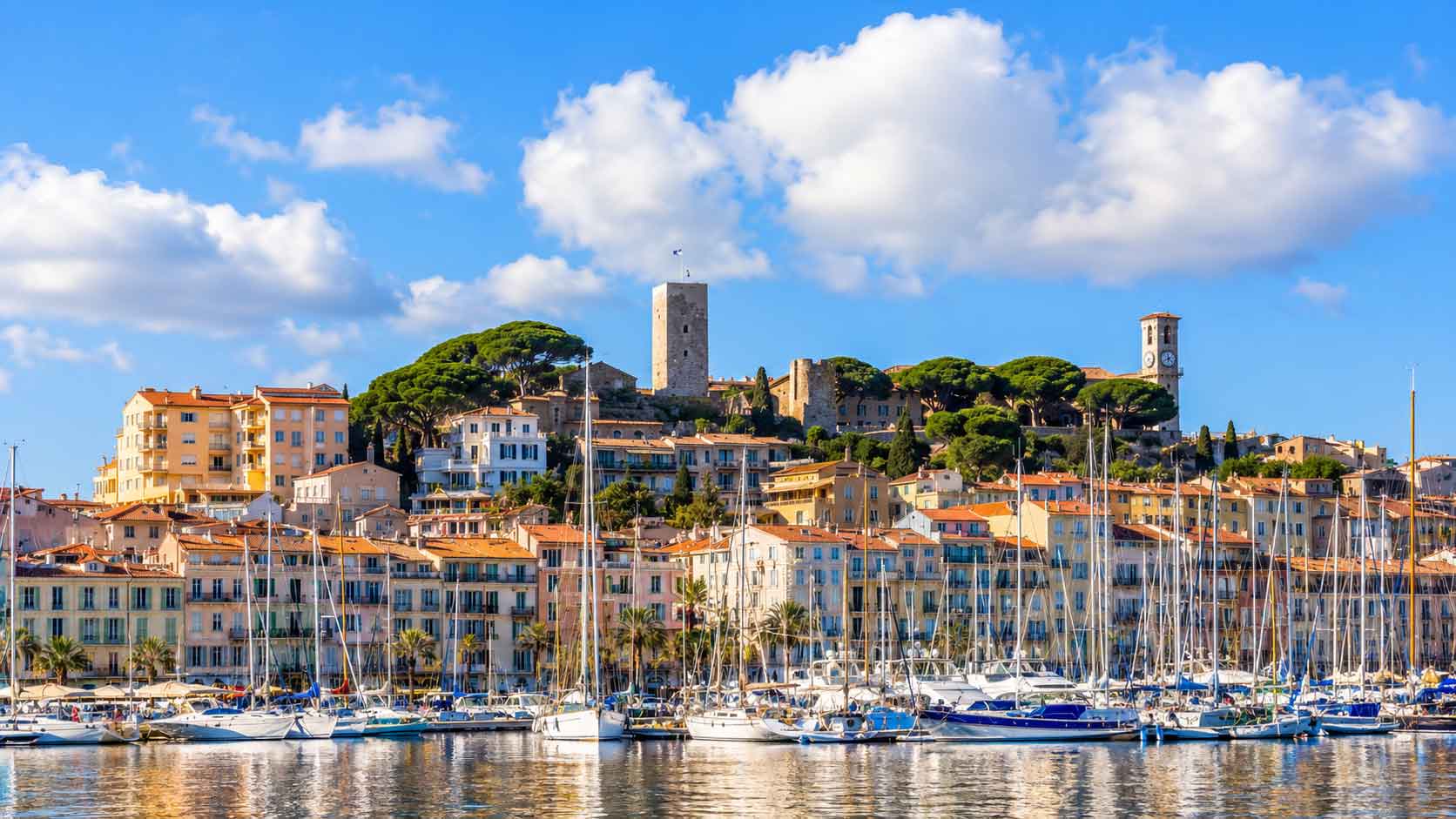
Cannes
Découvrez que faire à Cannes, capitale du cinéma sur la Côte d’Azur : Croisette, Palais des Festivals, quartier du Suquet, marché Forville, Vieux-Port, plages et îles de Lérins.
Visiting Cannes means discovering a French Riviera city famous around the world for its film festival, La Croisette, prestigious hotels and sandy beaches. Beyond its glamorous image, Cannes also offers a historic district, Provençal markets, protected natural areas and the beautiful Lérins Islands.
If you are looking for the best things to do in Cannes, beautiful places to see or an itinerary for visiting Cannes in one day, this SAVÙ travel guide will help you plan your stay. Discover the Palais des Festivals, La Croisette, Le Suquet, Forville Market, the Old Port, the beaches, Sainte-Marguerite Island and Saint-Honorat Island.
Best Things to Do in Cannes
1. Walk along La Croisette
Boulevard de la Croisette is the most famous place in Cannes. This waterfront promenade extends for approximately three kilometers between the Palais des Festivals and the Palm Beach area.
On one side, visitors will find the Mediterranean, sandy beaches and palm trees. On the other stand luxury boutiques, prestigious hotels and buildings that have contributed to the international reputation of Cannes.
The best-known hotels include the Carlton, Martinez and Majestic. Even if you are not staying at these properties, their historic façades form an important part of the city’s architectural heritage.
La Croisette is suitable for walking, cycling and running. It is particularly enjoyable early in the morning before the crowds arrive and toward the end of the day when the light softens over the bay.
SAVÙ tip: begin at the Palais des Festivals and continue toward the Roseraie gardens, Port Canto and Pointe Croisette. You can return by local bus or walk back while enjoying the view of the Lérins Islands.
2. See the Palais des Festivals and its red carpet
The Palais des Festivals et des Congrès is the symbol of modern Cannes. It hosts the Cannes Film Festival as well as numerous conferences, concerts, exhibitions and international events.
The famous steps and red carpet are located outside the main entrance at the beginning of La Croisette. Outside major events, visitors can generally approach the steps and take photographs.
The red carpet may occasionally be removed, and access to the steps can be restricted during installations, rehearsals or professional events.
Guided tours of the Palais are available on selected dates. They provide access to parts of the building, its auditoriums and areas associated with major Cannes events. Check the official program and book in advance.
3. Follow the Path of the Stars
Around the Palais des Festivals, the Path of the Stars displays handprints belonging to actors, directors and other personalities from the world of cinema.
More than one hundred handprints are set into the pavement around the Palais and nearby promenades. This free walk allows visitors to find the signatures of major figures from French and international cinema.
The handprints are not grouped inside a single enclosed attraction. Look carefully at the pavement while walking around the Palais and adjacent streets.
4. Explore the historic Le Suquet district
Le Suquet is the oldest neighborhood in Cannes. Built on a hill overlooking the Old Port, it preserves the memory of the period when Cannes was a small fishing village.
From Forville Market or Quai Saint-Pierre, follow the sloping lanes and staircases toward Place de la Castre. The route passes cobbled streets, vaulted passages, historic houses and small squares.
From the top of the hill, the panorama extends across the Old Port, La Croisette, the Bay of Cannes, the Lérins Islands and the Estérel mountains. The view is particularly attractive in the morning and shortly before sunset.
Rue Saint-Antoine, located near the bottom of Le Suquet, contains numerous restaurants. The neighborhood remains lively in the evening while preserving a more historic atmosphere than La Croisette.
5. Visit Notre-Dame-d’Espérance Church
Notre-Dame-d’Espérance Church stands at the top of Le Suquet near Place de la Castre. Constructed during the 17th century, it is one of the principal historic monuments in Cannes.
Its simple architecture and elevated position contrast with the modern image of La Croisette. The interior contains several religious artworks and historic objects.
Access may vary according to religious services, concerts and events. Visitors should remain quiet and respect any ceremonies taking place.
6. Discover the Museum of World Explorations
The Museum of World Explorations occupies the former medieval castle of Le Suquet. Its collections explore world cultures, Mediterranean antiquities, art and the landscapes of Cannes.
The site includes a courtyard, chapel and medieval square tower. When access to the tower is available, its summit provides one of the best panoramic views over Cannes and the surrounding bay.
Allow approximately one or two hours for your visit. Check current opening hours, admission prices and any restrictions affecting access to the tower.
7. Visit Forville Market
Located below Le Suquet and close to the Old Port, Forville Market is one of the most authentic places in Cannes. Farmers, fishmongers, butchers, cheese sellers and other traders offer fresh food and regional specialties.
The stalls feature seasonal fruit and vegetables, fish from the Bay of Cannes, flowers, cheese, olives, Provençal products and socca.
The food market generally takes place in the morning. It operates from Tuesday to Sunday during most of the year and may open daily during summer. On Mondays, the space traditionally welcomes an antiques and flea market.
Renovation or redevelopment work may temporarily change the location of some stalls. Check the current schedule and organization before visiting.
8. Walk around the Old Port
The Old Port is located between the Palais des Festivals and Le Suquet. It accommodates sailing boats, yachts, fishing vessels and passenger boats serving the Lérins Islands.
Quai Saint-Pierre, lined with restaurants, is one of the most pleasant waterfront walks in the center. From the harbor, visitors can enjoy a particularly photogenic view of the houses of Le Suquet and Notre-Dame-d’Espérance Church.
The Old Port also hosts several nautical events throughout the year. During these events, some quays may be occupied or subject to temporary access restrictions.
9. Go shopping on Rue d’Antibes
Rue d’Antibes is the principal shopping street in central Cannes. Running parallel to La Croisette, it contains international brands, French boutiques, perfume shops, cafés and other businesses.
Rue Hoche, Rue Meynadier and the surrounding streets provide additional shopping options. Pedestrianized Rue Meynadier, close to Forville Market, has a more traditional atmosphere.
The area between the railway station, La Croisette and Le Suquet is easy to explore on foot.
10. Find the cinema murals
Cannes has several large murals dedicated to cinema. They depict actors, films and famous scenes on building façades in different parts of the city.
Some of the best-known works feature Charlie Chaplin, Marilyn Monroe, Buster Keaton and other icons of cinema.
Following the mural route is free and provides an opportunity to explore neighborhoods beyond La Croisette. An official map or route will make the artworks easier to locate.
11. Enjoy the beaches of Cannes
Cannes has more than seven kilometers of sandy beaches. Its coastline includes free public beaches, municipal beaches and private establishments offering sun loungers, umbrellas and restaurants.
The beaches along La Croisette are the most famous and provide views toward the Lérins Islands. The beaches along Boulevard du Midi are generally wider and offer beautiful views of the Estérel mountains.
At Pointe Croisette, Gazagnaire and Mouré Rouge beaches are particularly popular with local residents. They are suitable for water sports and provide a different atmosphere from the city center.
12. Walk through La Croix-des-Gardes
La Croix-des-Gardes is a large natural area located on the western hills of Cannes, a short distance from the center and La Croisette.
Its paths cross Mediterranean vegetation, including pine trees and mimosa. Several viewpoints overlook the bay, the Lérins Islands and the Estérel mountains.
The park provides a peaceful alternative to the busy coastal districts. Wear appropriate footwear, carry drinking water and check access regulations during periods of high wildfire risk.
13. Discover Port Canto and Pointe Croisette
Port Canto is located at the eastern end of La Croisette. Less touristy than the Old Port, it provides an attractive walk overlooking sailing boats and the Lérins Islands.
Continue toward Pointe Croisette, Palm Beach and the Mouré Rouge harbor to discover another side of the Cannes coastline. This area is popular for beaches, water sports and waterfront walks.
14. Take a boat to the Lérins Islands
The Lérins Islands are among the best excursions from Cannes. Passenger boats reach Sainte-Marguerite and Saint-Honorat from the port in approximately 15 minutes, depending on the service and navigation conditions.
The two islands offer different experiences. Sainte-Marguerite combines forests, coves, Fort Royal and the history of the Man in the Iron Mask. Saint-Honorat is known for its monastery, vineyards and peaceful atmosphere.
Tickets, departure times and service frequency vary according to the season and weather. Always check the time of the final return boat before beginning your visit.
The History of Cannes
Before becoming an internationally famous seaside destination, Cannes was a small settlement centered around the hill of Le Suquet. Its position opposite the Lérins Islands gave it maritime and strategic importance.
The oldest surviving structures in Le Suquet preserve evidence of the city’s medieval past. The former castle, square tower and Notre-Dame-d’Espérance Church still overlook the harbor and bay.
The modern development of Cannes accelerated during the 19th century. In 1834, Lord Brougham, a former British Lord Chancellor, stopped in the area while traveling toward Italy. Impressed by the landscape and climate, he built a villa at La Croix-des-Gardes.
His presence gradually attracted British aristocrats and other European families. Large villas, gardens and hotels were constructed on the hills of La Croix-des-Gardes and La Californie.
The arrival of the railway encouraged further tourism. Cannes became a fashionable winter resort before developing into a year-round seaside destination.
The first Cannes Film Festival took place in 1946 and permanently transformed the city’s international image. Cannes became one of the world’s cinema capitals while also developing a major conference and events industry.
Best Beaches in Cannes
La Croisette beaches
The beaches along La Croisette are the most famous in Cannes. Many are occupied by private establishments associated with hotels, but several public beaches provide free access to the sand and sea.
Zamenhof and Macé are among the public options close to the center. Beach names and organization may change as the coastline is redeveloped.
Boulevard du Midi beaches
Located west of the Old Port, the Boulevard du Midi beaches offer sand, a waterfront promenade and open views toward the Estérel mountains. They are generally more spacious than some beaches along La Croisette.
The BoccaCabana area continues west toward Cannes-La Bocca with sports facilities, landscaped spaces and several public beaches.
Gazagnaire Beach
Gazagnaire is located at Pointe Croisette facing the Lérins Islands. The beach is appreciated for its more local atmosphere and the water sports available nearby.
Mouré Rouge beaches
Mouré Rouge is a family-friendly area on the other side of Pointe Croisette. It contains a sandy beach, a small harbor and a water sports center.
Coves of the Lérins Islands
Sainte-Marguerite and Saint-Honorat contain small rocky coves with clear water. Bring water shoes and remain cautious, as not every swimming area is supervised.
How to Visit the Lérins Islands
Visiting Sainte-Marguerite Island
Sainte-Marguerite is the largest of the Lérins Islands. It is covered by pine and eucalyptus forests crossed by relatively easy walking trails.
Fort Royal is home to the Museum of the Iron Mask and Fort Royal. The fortress is associated with the mysterious prisoner known as the Man in the Iron Mask.
An underwater eco-museum is located near the island. Its submerged sculptures can be reached by swimming from the shore by visitors with sufficient swimming experience. Check sea conditions and follow all safety instructions.
Allow at least half a day, although a full day provides enough time for walking, heritage sites, a picnic and swimming.
Visiting Saint-Honorat Island
Saint-Honorat is smaller and has a monastic atmosphere. The island is home to Lérins Abbey, a community of Cistercian monks and a vineyard.
A walking trail circles the island and connects its chapels, coves, vineyards and fortified monastery. Some parts of the abbey remain reserved for religious life.
Respect the silence, monastic property and areas closed to visitors. Check boat, service and visiting times before departure.
Practical advice for the islands
- Book boat tickets in advance during the high season.
- Check the departure time of the final return boat.
- Bring enough drinking water, especially during summer.
- Pack a picnic if you do not want to depend on island restaurants.
- Wear comfortable walking shoes and bring water shoes.
- Take your rubbish back to the mainland and use the appropriate containers.
- Do not remove plants, stones or marine objects.
How to Visit Cannes in One, Two or Three Days
Visiting Cannes in one day
Begin your morning at Forville Market before walking through the lanes of Le Suquet. Visit Notre-Dame-d’Espérance Church and enjoy the panorama from Place de la Castre.
Walk down toward the Old Port and continue to the Palais des Festivals. Take a photograph on the famous steps, look for handprints along the Path of the Stars and have lunch in the center.
During the afternoon, walk along La Croisette toward Port Canto or relax on a beach. Finish the day with an evening walk around the Old Port or dinner in Le Suquet.
Visiting Cannes in two days
Devote your first day to Forville Market, Le Suquet, the Museum of World Explorations, the Old Port, the Palais des Festivals and La Croisette.
On the second day, take a boat to Sainte-Marguerite or Saint-Honorat. After returning to Cannes, spend time on the beach or explore the shops along Rue d’Antibes.
Visiting Cannes in three days
With a third day, explore La Croix-des-Gardes, BoccaCabana, Pointe Croisette and the cinema murals.
You can also arrange an excursion to Antibes, Mougins, Grasse, Vallauris or Mandelieu-la-Napoule.
Best Time to Visit Cannes
- Spring offers pleasant temperatures for walking, sightseeing and excursions to the islands.
- May brings the Cannes Film Festival, large crowds and higher accommodation prices. Access to some areas can be restricted.
- Summer provides a lively atmosphere and excellent swimming conditions, but beaches and parking facilities are busier.
- Early fall often brings warm sea temperatures with gradually decreasing visitor numbers.
- Winter is quieter and suitable for walking, shopping and cultural visits.
June, September and early October generally offer an excellent combination of comfortable weather, swimming conditions and moderate visitor numbers.
How to Get to Cannes
Getting to Cannes by train
Cannes railway station is located in the city center, only a few minutes on foot from La Croisette, the Palais des Festivals and Rue d’Antibes.
Regional trains connect Cannes with Nice, Antibes, Monaco, Menton, Grasse, Saint-Raphaël and other destinations. Long-distance trains also provide connections with several French cities.
The train is often the most convenient option for a day trip, especially during major events and the summer season.
Getting to Cannes by car
Cannes is accessible from the A8 motorway and coastal roads. Exits and routes leading into the center can become congested during peak hours and major events.
If you are staying in the center, check whether your accommodation provides parking. On-street parking is limited and regulated in many areas.
Getting to Cannes from Nice Airport
Nice Côte d’Azur Airport is the principal airport serving Cannes. Depending on your schedule and budget, you can travel by bus, train using the appropriate connection, taxi, private transfer or rental car.
Schedules and departure points may change, so confirm your route on the day of travel.
Parking and Getting Around Cannes
Several public parking facilities are located near the Palais des Festivals, La Croisette, the Old Port, Forville Market and the railway station.
Central parking facilities can fill quickly during conferences, festivals, weekends and the summer season. Arrive early and check current traffic conditions before traveling.
Central Cannes is easy to explore on foot. The railway station, Palais des Festivals, Old Port, Forville Market, La Croisette and Le Suquet are relatively close to one another.
Local buses serve Pointe Croisette, Cannes-La Bocca, residential districts and neighboring communes. Bicycles, taxis and private car services are also available.
Passenger boats provide transportation to the Lérins Islands. Cars are neither needed nor permitted for exploring the islands.
Where to Stay and Eat in Cannes
Staying near La Croisette
This area is suitable for travelers seeking beaches, prestigious hotels, boutiques and proximity to the Palais des Festivals. Prices are generally higher, especially during major events.
Staying in the city center
The area around the railway station and Rue d’Antibes is convenient for train travel, shopping and walking to the principal attractions.
Staying near Le Suquet
Le Suquet and the streets around the Old Port offer a historic atmosphere, numerous restaurants and easy access to Forville Market.
Staying in Cannes-La Bocca
Cannes-La Bocca may provide accommodation away from the busiest part of the center, with access to the Boulevard du Midi beaches and BoccaCabana promenade.
What to eat in Cannes
Try Mediterranean fish, seafood, socca, pissaladière, pan bagnat, Provençal vegetables and products made with local olives.
Forville Market is an excellent place to discover regional producers and specialties. Reservations are recommended for dinner in Le Suquet, the Old Port and La Croisette during summer and major events.
Places to Visit Around Cannes
- Antibes: a fortified old town with the Picasso Museum, Port Vauban and Cap d’Antibes.
- Juan-les-Pins: a seaside resort known for its sandy beaches and jazz festival.
- Mougins: a hilltop village appreciated for its lanes, galleries and restaurants.
- Grasse: the historic perfume capital located in the hills above the coast.
- Vallauris: a ceramics town closely associated with Pablo Picasso.
- Biot: an artists’ village known for glassmaking and the Fernand Léger National Museum.
- Mandelieu-la-Napoule: beaches, marinas, Château de La Napoule and access to the Estérel.
- Théoule-sur-Mer: coves, beaches and the red-rock landscapes of the Estérel.
- Saint-Paul-de-Vence: a fortified village famous for its artistic heritage.
- Nice: home to the Promenade des Anglais, Old Nice, museums and markets.
Cannes is a convenient base for exploring the French Riviera by train. Antibes, Grasse, Nice and several coastal destinations can be visited without a car.
Tips for Visiting Cannes Responsibly
- Use trains and public transportation whenever possible.
- Use public beaches and official access points to the coastline.
- Do not leave rubbish on the beaches or Lérins Islands.
- Respect natural areas and remain on marked trails.
- Avoid disturbing marine animals and birds.
- Do not use soap or polluting products in beach showers.
- Respect the silence and religious areas of Saint-Honorat.
- Support market producers and independent businesses.
- Conserve water, particularly during periods of drought.
- Check wildfire restrictions before entering natural areas.
Frequently Asked Questions About Cannes
Is Cannes worth visiting?
Yes. Cannes offers much more than its film festival and luxury hotels. The city has a historic neighborhood, markets, beaches, museums, waterfront walks and direct access to the Lérins Islands.
How long do you need to visit Cannes?
One day is enough to see Le Suquet, Forville Market, the Palais des Festivals, the Old Port and La Croisette. Allow two days if you want to visit one of the Lérins Islands.
Can you explore Cannes on foot?
Yes. The principal attractions in the center are close to one another. However, Le Suquet contains sloping streets and staircases.
Can you visit Cannes without a car?
Yes. The railway station is in the city center, and trains serve numerous French Riviera destinations. Local buses connect the more distant districts.
What should you do in Cannes in one day?
Visit Forville Market and Le Suquet during the morning, followed by the Old Port and Palais des Festivals. Spend the afternoon walking along La Croisette and relaxing on a beach.
Which Lérins Island should you choose?
Choose Sainte-Marguerite for forest trails, coves, Fort Royal and the story of the Man in the Iron Mask. Choose Saint-Honorat for its monastery, vineyard and more spiritual atmosphere.
How long do you need to visit the Lérins Islands?
Half a day is enough for an initial visit, but a full day is better for walking, visiting historic sites, having a picnic and swimming.
Are the beaches in Cannes free?
Cannes has free public beaches as well as paid private beaches. Private establishments generally offer sun loungers, umbrellas, restaurants and additional services.
What is the best beach in Cannes?
The beaches along La Croisette are the most famous. The Boulevard du Midi beaches are more spacious, while Gazagnaire and Mouré Rouge offer a more local atmosphere.
Can you see the red carpet throughout the year?
The steps of the Palais des Festivals are visible throughout the year, but the red carpet may be removed or access restricted during installations and events.
Can you attend the Cannes Film Festival without an invitation?
Many official screenings and professional areas require accreditation or an invitation. However, visitors can still enjoy the atmosphere, public events and occasional open-air screenings.
What can you do in Cannes for free?
You can walk along La Croisette, see the steps of the Palais, find handprints on the Path of the Stars, explore Le Suquet, visit Forville Market, discover the cinema murals and enjoy the public beaches.
Is Cannes suitable for families?
Yes. The sandy beaches, waterfront walks, Lérins Islands and many water activities are suitable for families. When visiting the islands, bring enough water and supervise children near rocky coves.
Where can you watch the sunset in Cannes?
The Boulevard du Midi beaches offer beautiful views toward the Estérel mountains. Le Suquet, the Old Port and parts of La Croisette are also attractive toward the end of the day.
What is the best time to visit Forville Market?
Arrive in the morning, preferably before late morning, to find the widest selection of products. Check the official opening hours and any temporary changes related to renovation work.
City Gallery